

Key takeaways
- The Poodle parent sets Goldendoodle size: Petful lists minis at 20 to 35 pounds, mediums at 35 to 50 and standards at 50 to 90.
- Sources disagree on the bands, and the puppy formula of weight over weeks times 52 overshoots Petful's own ranges by as much as 14 pounds.
- Feeding a neutered Goldendoodle costs about $260 a year at 20 pounds and $805 at 90 pounds, and a 2026 study found Poodles and Poodle mixes had the highest odds of bloat.
Your Goldendoodle's adult weight depends mostly on the Poodle parent. Petful lists miniatures at 20 to 35 pounds, mediums at 35 to 50 and standards at 50 to 90. This Goldendoodle weight calculator covers the size bands, weight by age, the formula that fails, and what each size costs to feed.
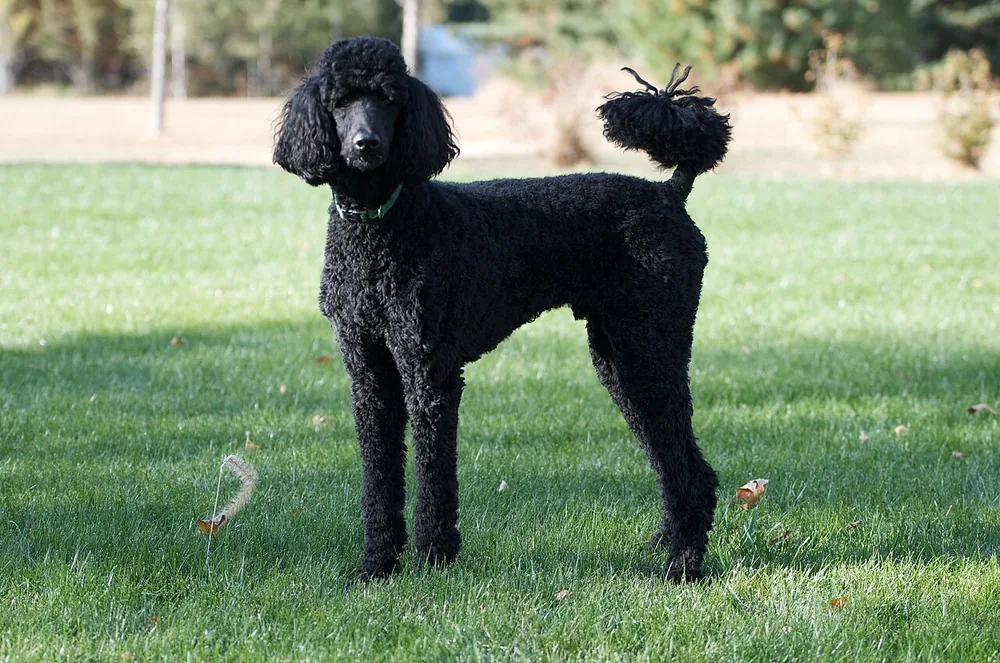 Photo: Tim Wilson / Wikimedia Commons, CC BY 2.0

Goldendoodle size chart: four sizes, two sources
A Goldendoodle falls into one of four size bands, set by the Poodle parent. No kennel club writes a Goldendoodle standard. Every chart is a breeder convention. Petful's Goldendoodle size guide, published July 14, 2026, gives these bands.
| Size | Adult weight | Shoulder height | Poodle parent |
|---|---|---|---|
| Petite ("teacup") | 15-25 lb | 11-14 in | Toy or small miniature |
| Mini | 20-35 lb | 14-17 in | Miniature |
| Medium | 35-50 lb | 17-20 in | Small standard |
| Standard | 50-90 lb | 20-24 in | Standard |
Petful notes that "teacup" is a marketing term and not an official category. Wikipedia's Goldendoodle entry draws the lines in slightly different places.
Sources do not agree. Our Goldendoodle price guide quotes Spot Pet Insurance at 40 to 50 pounds for a standard, below both charts above. Treat every band as a range of likely outcomes. The breeder's parent weights are better evidence than any chart.
Goldendoodle weight calculator: start with the parents
The most useful Goldendoodle weight calculator uses both parents' adult weights. A cross lands between its parents, so averaging them gives a first guess. PetBudget's breed data lists these parent weights.
| Parent | Weight range | Midpoint |
|---|---|---|
| Golden Retriever | 55-75 lb | 65 lb |
| Toy Poodle | 4-6 lb | 5 lb |
| Miniature Poodle | 15-17 lb | 16 lb |
| Standard Poodle | 40-70 lb | 55 lb |
Average the Golden's 65 pounds with each Poodle's midpoint. A Toy Poodle cross comes to 35 pounds, a Miniature Poodle cross to 40 pounds and a Standard Poodle cross to 60 pounds. A 35-pound result tops the mini band, 40 pounds is a medium and 60 pounds is a standard. The Toy Poodle result runs high, since Petful puts toy crosses at 15 to 25 pounds.
This is PetBudget arithmetic, not a validated formula. Use it to sanity-check a breeder's claim, not to predict a single dog.
Goldendoodle growth chart: weight by age
A standard Goldendoodle roughly quadruples its weight between 8 weeks and 6 months. Petful gives weights at three ages for each size.
| Size | 8 weeks | 3 months | 6 months | Near-final weight |
|---|---|---|---|---|
| Mini (adult 15-35 lb) | 5-6 lb | 9-12 lb | 17-22 lb | 11-13 months |
| Medium (adult 30-45 lb) | 8-10 lb | 18-24 lb | 28-36 lb | 12-14 months |
| Standard (adult 45-90 lb) | 10-14 lb | 22-30 lb | 40-50 lb | Still filling out at 14-18 months |
The adult ranges in this table differ from the size chart above. Petful uses 15 to 35 pounds for a mini here and 20 to 35 above. Watch the pattern of growth more than the labels.
Why the simple puppy formula overshoots
The common puppy formula multiplies current weight over age in weeks by 52. Our puppy weight calculator guide explains it. It assumes steady growth all year, and Goldendoodles grow fast early and slow later.
Run Petful's own midpoints through it and the answers run high:
| Puppy | Formula result | Petful adult range |
|---|---|---|
| Mini, 8 weeks (5.5 lb) | 36 lb | 15-35 lb |
| Mini, 3 months (10.5 lb) | 42 lb | 15-35 lb |
| Mini, 6 months (19.5 lb) | 39 lb | 15-35 lb |
| Standard, 3 months (26 lb) | 104 lb | 45-90 lb |
| Standard, 6 months (45 lb) | 90 lb | 45-90 lb |
Every mini result lands above the top of the mini range. The standard result at 3 months is 14 pounds over the top of its range. The formula does better at 6 months, when growth has slowed.
14 lb
How far the weight-over-weeks formula overshoots the top of Petful's standard Goldendoodle range for a 3-month puppy. Get a budget built on your dog's real weight in the PetBudget calculator.
How big will my Goldendoodle get? Five steps
You can narrow the estimate in five steps:
- Get the parents' adult weights from the breeder, in writing.
- Find the Poodle parent's variety: toy, miniature or standard.
- Match it to a band in the Petful table above.
- Weigh the puppy weekly on the same scale.
- Compare to the age table and expect a standard to keep growing past a year.
Generation matters less for size than for coat. Petful lists an F1 cross (Golden Retriever by Poodle) as wavy and varied by litter. An F1b (F1 bred back to a Poodle) is curlier and more consistent, and an F2 is highly variable. Petful ties size to the Poodle parent, not the generation.
When do Goldendoodles stop growing?
Small Goldendoodles finish near the first birthday, and standards take longer. Petful says petite and mini dogs are essentially done by 11 to 13 months. Mediums reach full height by about 12 months and final weight by about 14 months. Standards reach adult height near 14 months, and muscle and weight may build until 18 months.
The Elanco puppy growth chart fits that pattern. It puts medium breeds at about 1 year and large breeds at 14 to 18 months.
Male and female Goldendoodle weight
Male Goldendoodles run heavier than females. Wikipedia lists males at about 22 inches and 55 to 75 pounds, and females at about 20 inches and 40 to 65 pounds. That gap is up to 15 pounds on the same cross.
Use the female range when a breeder quotes a litter average. A male from the same litter can land a size band higher. Sex also shifts the food bill by roughly $100 a year at these weights.
Bigger Goldendoodles cost more to feed
A 90-pound Goldendoodle costs three times as much to feed as a 20-pound one. The table applies PetBudget's food formula to a neutered adult. It uses the Merck Veterinary Manual factor of 1.6 times resting energy, plus 10% treats, at $3.99 a kilogram.
| Adult weight | Calories a day | Food a year | Cups a day |
|---|---|---|---|
| 20 lb | 644 | $260 | 1.7 |
| 35 lb | 980 | $396 | 2.5 |
| 50 lb | 1,280 | $518 | 3.3 |
| 70 lb | 1,648 | $666 | 4.2 |
| 90 lb | 1,990 | $805 | 5.1 |
The cups assume 388 calories a cup, a typical value. Check your bag's label. PetBudget's parent models use the intact factor of 1.8. They put food at $249 a year for a Miniature Poodle, $627 for a Standard Poodle and $711 for a Golden Retriever. Our dog feeding guide shows the full method.
Food is only one line. Our Goldendoodle price guide builds the whole budget from the Standard Poodle model. The Standard Poodle and Golden Retriever pages show each parent's costs.
Questions to ask the breeder about size
A breeder who sells by size band should back it with numbers. Ask these questions before you pay a deposit:
- What do both parents weigh as adults, and when were they weighed?
- Is the Poodle parent a toy, a miniature or a standard?
- How much did adult dogs from earlier litters weigh?
- Is the size band a guess or a guarantee, and is that in the contract?
- Which generation is the cross: F1, F1b, F2 or multigen?
Vague answers are a warning. A seller who says "teacup" and cannot name the parents' weights is selling a label.
Is your Goldendoodle at a healthy weight?
Weight alone does not tell you if a Goldendoodle is healthy, because the healthy range spans 20 to 90 pounds. Check body condition instead. You should feel the ribs under a thin layer of fat, and see a waist from above.
Owners often misjudge it. The Association for Pet Obesity Prevention reports that 59% of U.S. dogs were overweight or obese in 2022. In its 2023 owner survey, only 17% of dog owners called their own dog overweight. Another 84% said their dog was ideal or healthy.
Thin is not automatically safe either. The Dog Aging Project study below found higher bloat odds in dogs with a low body condition score. Aim for the middle of the scale and ask your vet to score your dog at each visit.
Size, bloat and other health risks
Bigger Goldendoodles carry more bloat risk. A 2026 Dog Aging Project study in the Journal of the American Veterinary Medical Association drew on 47,444 enrolled dogs. Odds of bloat were higher in purebreds, males, dogs over 40 kilograms (88 pounds) and dogs with a low body condition score.
The study also called one result novel. Poodles had the highest occurrence of bloat of any breed, and Poodle mixes also showed higher odds. It found no link to diet type or the number of meals a day. Lifetime prevalence overall was 0.23%.
Wikipedia adds that Goldendoodles are prone to megaesophagus, a swallowing disorder. Ask your vet about a preventive stomach tack at spay or neuter. Our emergency vet cost guide shows what a bloat emergency costs.
Frequently asked questions
How big will my Goldendoodle get?
Look at the Poodle parent. Petful lists minis at 20 to 35 pounds, mediums at 35 to 50 and standards at 50 to 90. Ask the breeder for both parents' adult weights, because no breed standard fixes Goldendoodle size.
How much does a Goldendoodle weigh at 6 months?
Petful's table shows 17 to 22 pounds for a mini, 28 to 36 for a medium and 40 to 50 for a standard at 6 months. A standard may keep filling out until 14 to 18 months.
When do Goldendoodles stop growing?
Petful says minis finish at 11 to 13 months and mediums by about 14 months. Standards reach adult height near 14 months and may add muscle until 18 months.
Is a teacup Goldendoodle a real size?
No. Petful calls teacup a marketing term, not an official category. Its smallest listed size is petite at 15 to 25 pounds. Ask what the puppy's parents weigh instead of trusting the label.
Are Goldendoodles prone to bloat?
A 2026 Dog Aging Project study found the highest odds of bloat in Poodles and Poodle mixes. It also found higher odds above 40 kilograms. Ask your vet about a preventive stomach tack at spay or neuter.
See your own pet's real numbers.
Run the calculator with your breed, metro area, and care choices for a first-year, annual, and lifetime cost estimate — not a national average.
Comments
Comments are moderated before they appear. Constructive questions, corrections and first-hand pet cost experiences are welcome.
Verified Dialogue
Sort by: Chronological (earliest)Loading comments…