

Key takeaways
- A neutered adult dog needs about 1.6 times its resting energy, which works out to roughly 1 cup of dry food a day for a 10-pound dog and 3 cups for a 50-pound dog.
- Wet food needs about 20% more volume than dry in cans and costs 2 to 4 times as much per calorie, so a half-and-half mix costs about twice what all kibble does.
- Food labels vary widely in calories per cup, so use the chart as a starting point and adjust every 2 to 4 weeks by your dog's body condition.
A neutered adult dog needs about 1.6 times its resting energy each day. For a 10-pound dog that is roughly 350 calories, or about 1 cup of dry food. For a 50-pound dog it is about 1,160 calories, or about 3 cups. This guide answers how much to feed your dog by weight for dry, wet, and mixed food, and shows what each costs a month.
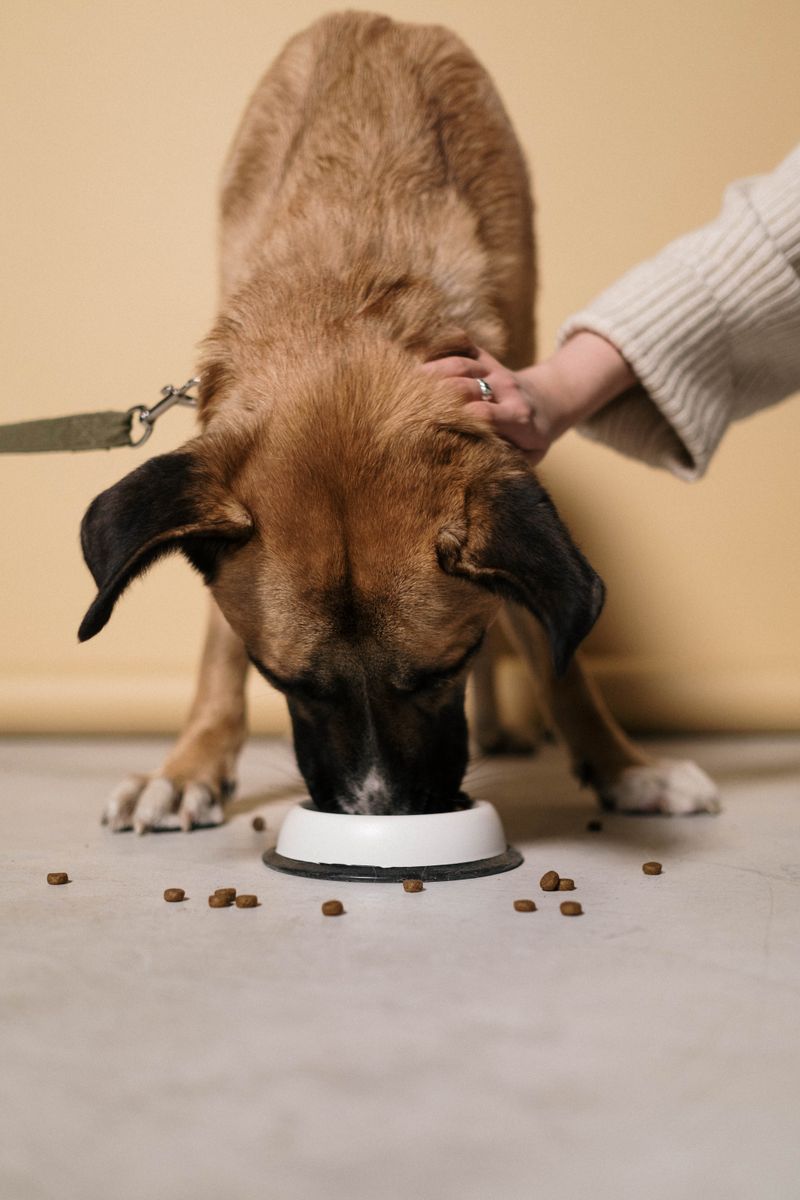 Photo: cottonbro studio / Pexels
How much should I feed my dog? The formula
How much to feed your dog comes down to daily calories, then calories per cup. Start with resting energy requirement (RER), which equals 70 times body weight in kilograms to the 0.75 power. Then multiply by a life-stage factor. PetBudget uses the same RER formula in its food cost model.
The Merck Veterinary Manual lists the factors. Neutered adults use 1.6 x RER and intact adults use 1.8 x RER. Obesity-prone dogs use 1.4 x RER, and puppies use 3 x RER under 4 months and 2 x RER after, per the Merck Veterinary Manual energy table. The manual adds that any calorie calculation is only a starting point.
Here is a worked example for a neutered 50-pound dog:
- Convert to kilograms: 50 lb is 22.7 kg.
- Find RER: 70 x 22.7 to the 0.75 power is about 727 calories.
- Multiply by 1.6 for a neutered adult: about 1,164 calories a day.
- Divide by the calories in a cup of your food. At 388 calories a cup, that is 3 cups.
Dog food amount by weight: the feeding chart
This feeding chart for dogs uses the neutered adult factor of 1.6 x RER. It assumes dry food at 388 calories per cup and wet food at 325 calories per 13-ounce can, which are typical values. Petfinder puts dry dog food near 97 calories per ounce and wet food near 25 calories per ounce, as its dry food calorie page and its wet food calorie page show.
| Dog weight | Calories a day | Dry (cups) | Wet (13 oz cans) | Half-and-half mix |
|---|---|---|---|---|
| 5 lb | 207 | 0.5 | 0.6 | 0.3 cup + 0.3 can |
| 10 lb | 348 | 0.9 | 1.1 | 0.5 cup + 0.5 can |
| 20 lb | 585 | 1.5 | 1.8 | 0.8 cup + 0.9 can |
| 30 lb | 794 | 2.1 | 2.4 | 1.0 cup + 1.2 cans |
| 40 lb | 985 | 2.5 | 3.0 | 1.3 cups + 1.5 cans |
| 50 lb | 1,164 | 3.0 | 3.6 | 1.5 cups + 1.8 cans |
| 60 lb | 1,335 | 3.4 | 4.1 | 1.7 cups + 2.1 cans |
| 80 lb | 1,656 | 4.3 | 5.1 | 2.1 cups + 2.6 cans |
| 100 lb | 1,958 | 5.1 | 6.0 | 2.5 cups + 3.0 cans |
Divide these numbers across two meals. Your food's real calories per cup will move them up or down, so read the kcal per cup on your bag. A food at 300 calories per cup needs about 30% more volume than one at 388.
1,164 calories
The daily energy need of a neutered 50-pound adult dog, about 3 cups of dry food. Get a monthly food cost for your own dog's breed in the PetBudget calculator.
How much wet food to feed a dog
The amount of wet food to feed a dog depends on the calories in each can. A 13-ounce can runs about 325 calories on average, but one brand may carry 250 and another 500. Divide your dog's daily calories by the kcal per can on the label.
A 10-pound dog needs about 1.1 cans a day and a 50-pound dog about 3.6 cans, using the chart above. Wet food is mostly water, so it takes more volume to deliver the same calories. That is why a 50-pound dog goes from 3 cups of dry to nearly 4 cans of wet.
Mixing wet and dry dog food
Mixing wet and dry dog food works best when you split calories, not volume. Choose the share you want from each, such as 50% wet and 50% dry. Then divide each half by that food's calories per cup or per can.
For a 30-pound dog on a 50/50 mix, the chart shows about 1 cup of dry plus 1.2 cans of wet. Never add a full wet portion on top of a full dry portion. That doubles the calories and is a fast route to weight gain.
What each feeding style costs a month
Feeding style changes the monthly bill more than the brand. PetBux reports that wet or canned food costs 2 to 4 times as much as kibble per calorie. The table uses a mid-tier kibble price of $2.50 a pound, about 4 ounces a cup, as an illustration. It sets wet at 3 times the kibble price per calorie.
| Dog weight | All dry | Half-and-half | All wet |
|---|---|---|---|
| 10 lb | about $17 | about $34 | about $50 |
| 20 lb | about $28 | about $57 | about $85 |
| 30 lb | about $38 | about $77 | about $115 |
| 50 lb | about $56 | about $112 | about $169 |
| 80 lb | about $80 | about $160 | about $240 |
| 100 lb | about $95 | about $189 | about $284 |
A half-and-half mix costs about twice what all kibble costs. All wet costs about three times as much. Your prices will differ, so plug in your bag price. Monthly cost equals cups a day times 30 times the price per cup.
The kibble column lines up with PetBux's published ranges of $35-$65 a month for a medium dog and $55-$100 for a large dog. For a full breakdown by size and food type, see our dog food cost guide.
How much should a puppy eat?
A puppy needs more calories per pound than an adult. The Merck table puts puppies under 4 months at 3 x RER and puppies over 4 months at 2 x RER, compared with 1.6 x RER for a neutered adult. A growing puppy should eat a food made for puppies, in the amount on that label.
Check growth against a chart, not appetite. Our puppy weight guide shows how to track the curve and when to call your vet.
How to check you are feeding the right amount
Treat every number here as a starting point, then adjust. The Association for Pet Obesity Prevention advises owners to use a gram scale when possible, cap treats at 10% of daily calories, and reassess every 2 to 4 weeks.
Use these checks:
- Feel the ribs. You should feel them under a thin layer of fat without pressing hard.
- Look for a waist. Seen from above, a healthy dog narrows behind the ribs.
- Weigh monthly. A steady rise on a fixed diet means feeding less.
- Count treats. Chews and training treats add real calories.
Adjust the daily amount by about 10% and recheck in 2 to 4 weeks. If your dog is overweight, ask your vet for a target weight. Calculate calories for that weight, not the current one.
Where food fits in the dog budget
Food and vet care are the two biggest slices of a dog's spending. Dog ownership reached 71 million US households in 2025, per the APPA 2026 Dog Report. Veterinary care takes 29% of owners' dog spending and food takes 27%.
In PetBudget's model, a Labrador Retriever spends $732 a year on food out of $2,813 total. Overfeeding raises the food line and the vet line, because extra weight adds joint and metabolic risk. For the full cost picture, read how much a dog costs.
Turn the feeding chart into a budget
Find your dog's weight in the chart, pick dry, wet, or mixed, and read off the cups and the monthly cost. Then check body condition and adjust.
For a food cost tuned to your dog's breed, use the PetBudget calculator. It builds the food line from the same calorie formula used here, and the methodology page explains each input.
Frequently asked questions
How much should I feed my dog?
A neutered adult dog needs about 1.6 times its resting energy, or 112 x body weight in kilograms to the 0.75 power, in calories a day. That is about 350 calories for a 10-pound dog and 1,160 for a 50-pound dog. Divide by the calories per cup on your food's label.
How much wet food should I feed my dog?
A 13-ounce can holds about 325 calories, though labels range widely. A 10-pound dog needs a little over 1 can a day and a 50-pound dog about 3.5 cans. Always check the kcal per can on your brand, because it can run from 250 to 500.
How do I mix wet and dry dog food?
Pick the share of calories you want from each, such as half and half, then divide each half by that food's calories per cup or can. A 30-pound dog on a 50/50 mix gets about 1 cup of dry plus 1.2 cans of wet. Do not give a full dry ration plus a full wet ration.
Should I feed my dog the amount on the bag?
Use the bag as a starting point and adjust. Veterinary sources say any calorie calculation is only a start and may need changing based on how the dog responds. Reassess every 2 to 4 weeks and adjust slowly.
How much more does a puppy eat?
Puppies under 4 months need about 3 times their resting energy, and puppies over 4 months need about 2 times, per the Merck Veterinary Manual. An adult neutered dog needs 1.6 times. Feed puppies the amount on a puppy-formula label and check growth with your vet.
See your own pet's real numbers.
Run the calculator with your breed, metro area, and care choices for a first-year, annual, and lifetime cost estimate — not a national average.