

Key takeaways
- Teeth give the most accurate age clue for puppies, since all adult teeth are in by about 6 months, but adult dogs between roughly 2 and 8 years are hard to age by looks alone.
- Gray muzzle hair, a bluish cloudy lens, tartar, and stiff joints point to an older dog, but breed and genetics shift each sign by years.
- A vet exam estimate is usually folded into a routine visit that averages $214 for dogs, per the AVMA, while Embark's DNA age test starts at $109 and lands within 12 months for 77% of dogs.
The fastest way to tell a dog's age is to check the teeth, then confirm with the coat, eyes, and movement. Teeth are precise for puppies and rough for adults. This guide gives an age-by-sign table, explains what a vet can add, and shows how the estimate changes your budget.
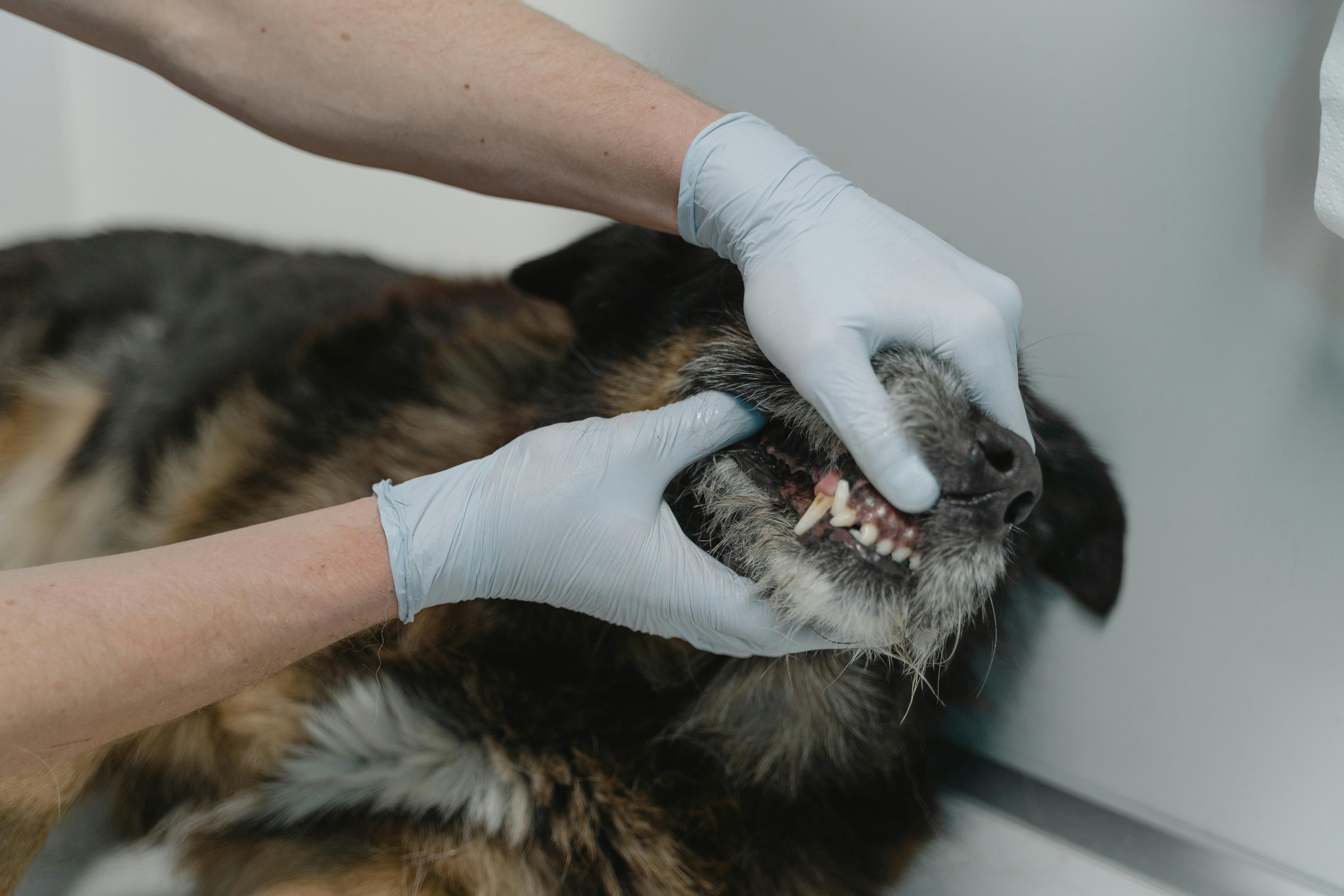 Photo: Tima Miroshnichenko / Pexels
How to tell a dogs age: the quick checklist
How to tell a dogs age comes down to four checks you can do at home in ten minutes. Look at the teeth, the coat, the eyes, and the way your dog moves. Each one narrows the range, and together they usually land within a few years.
Work through this order:
- Teeth. Count them, check color, and look for tartar and wear.
- Coat. Look for gray hair on the muzzle, eyebrows, and paws.
- Eyes. Look for a bluish haze or a milky white cloud.
- Body and movement. Watch stairs, jumping, and morning stiffness.
Adult dogs between about 2 and 8 years are the hard group. Embark notes that age is difficult to determine for dogs between about 2 and 8 calendar years from physical features alone. Be ready for a range of several years in that window.
Puppy age: what teeth show
Puppy age is the one case where teeth give a near-exact answer. Baby teeth appear at about 2-4 weeks, and a puppy has all 28 baby teeth by 5-8 weeks. Adult teeth then begin replacing them at roughly 3.5-4 months.
By six months, a puppy should have its adult teeth, per AKC's guide to telling a dog's age. An adult dog has 42 teeth, according to VCA Animal Hospitals.
Use this table for how old a puppy is by its mouth:
| What you see | Approximate puppy age |
|---|---|
| Tiny, needle-sharp baby teeth just coming in | 2-4 weeks |
| Full set of 28 small baby teeth | 5-8 weeks |
| Front baby teeth falling out, bigger teeth showing | 3.5-4 months |
| Mixed baby and adult teeth, drooling and chewing | 4-6 months |
| Full set of large, clean, white adult teeth | 6-7 months or older |
If you are asking how old a puppy is and the teeth are all adult and spotless, you are looking at a dog of at least 6 months. After that, the tooth clues get fuzzier.
How do you tell how old a dog is after puppyhood?
After about 7 months, how do you tell how old a dog is by teeth? You read wear and buildup. Tartar, staining, tooth wear, and gum disease all increase with age, according to Embark's veterinary guide. Small breeds tend to show worse dental disease at younger ages.
The American Veterinary Dental Society found that more than 80% of dogs have some degree of periodontal disease by age three, as reported by AKC. That means heavy tartar by age 3 is common, not a sign of old age. Diet, chewing habits, and home dental care shift the picture a lot.
Use this rough guide for adult teeth:
| Tooth condition | Likely age range |
|---|---|
| White, sharp, no tartar | Under 2 years |
| Light yellowing, mild tartar near the gumline | 2-4 years |
| Heavy tartar, red gums, some wear | 4-8 years |
| Worn or missing teeth, advanced gum disease | 8 years and up |
Treat that table as a starting point. A dog that gets daily brushing can look five years younger by teeth alone.
Coat: gray hair and what it means
Gray hair is a sign your dog is past puppyhood, but it is a weak clue for exact age. Age-related graying typically shows first on the muzzle and around the eyes, and most often appears in dogs aged 5-8 years, according to PetMD's guide to determining a dog's age.
Genetics matter as much as years. Some dogs gray early, and stress can speed it up. Coat texture also changes. Older dogs often have thinner, coarser, or duller fur.
Treat graying as a "probably over 5" signal. It cannot separate a 6-year-old from a 10-year-old.
Eyes: cloudy lens versus cataracts
A bluish haze in the center of the eye is usually lenticular sclerosis, a normal aging change. A milky white cloud is more likely a cataract, which can impair vision. Embark's veterinary guide describes both, and says lens haze usually does not blind the dog.
Lens sclerosis commonly develops at about 6-8 years. Eye changes become nearly universal in old age. AKC reports that half of dogs older than nine and almost all dogs older than 13 are estimated to have cataracts, lens sclerosis, or both.
Always have a vet check cloudy eyes. Cataracts, glaucoma, and dry eye can look similar and need different care.
Body, joints, and behavior
An older dog moves, rests, and holds its weight differently. Fat pads often build over the lower back, and muscle loss makes the spine and hips more prominent, per Embark's guide. Stiffness after naps and reluctance to jump onto the couch are common senior signs.
Cognitive changes also point to age. AKC cites rates of canine cognitive dysfunction at 28% in dogs 11 to 12 years old, rising to 68% in dogs 15 to 16. Signs include night waking, confusion, and house-soiling in a previously trained dog.
Do not read too much into any one sign. Arthritis can hit a 4-year-old large breed, and a fit 12-year-old terrier can still run.
Age-by-sign table
This table combines the signs above into one chart. Use it to place your dog in a life-stage range, then adjust for breed size.
| Sign | Puppy (under 1) | Young adult (1-3) | Mature (4-7) | Senior (8+) |
|---|---|---|---|---|
| Teeth | Baby teeth, then adult teeth by 6-7 months | Clean, white, sharp | Tartar, yellowing, wear | Worn, missing, gum disease |
| Coat | Soft, fluffy | Full, glossy | A few gray hairs on muzzle | Gray muzzle, thinner coat |
| Eyes | Bright, clear | Clear | Clear to slight haze | Bluish haze, possible cataracts |
| Mobility | Clumsy, bursts of energy | Athletic | Mostly steady | Stiff, slower, struggles on stairs |
| Behavior | Playful, learning | High energy | Settled | Sleeps more, may have night waking |
6 months
By this age a puppy should have all its adult teeth, per AKC. It is the last point where teeth give a precise age. After it, expect a range of years, not months.
How does dog age work by size?
How does dog age work once you know the number? Small dogs age more slowly than large ones. AKC notes that large breeds may be considered seniors at 5-6 years, standard-size dogs at 7 years, and small dogs not until 8-10 years.
That is why an age estimate is not enough on its own. Pair it with your dog's size. Our dog years to human years chart shows exactly how many human years each dog year equals by weight class.
What a vet can tell you
A vet gives a range, not a birth date. They combine teeth, eyes, coat, body condition, and joint health, and compare the dog with others of the same breed and type they have seen. Experience matters. The estimate is tightest for puppies and weakest in the 2-8 year middle.
An age estimate is usually part of a regular exam, not a separate service. A routine vet visit averages $214 for dogs, per the AVMA figure in our vet visit cost guide. A basic exam alone typically runs $50-$250 depending on the clinic.
Ask for the age estimate to be written in your dog's record. Shelters and rescues often list an estimated age that may be off by years, and a vet's note gives you a consistent baseline for vaccine and wellness timing. The estimate also helps you plan costs if you just finished adopting a dog.
DNA age tests: cost and accuracy
A DNA age test measures how chemical tags on your dog's DNA change with age. Embark's Dog Age Test uses this DNA methylation clock and starts at $109, per Embark's age test page. A bundle with its breed and health test is listed at $239.
Embark reports these accuracy numbers:
| Prediction window | Share of dogs inside it |
|---|---|
| Within 12 months of true birthday | 77% |
| Within 18 months | 90% |
| Within 22 months | 95% |
The test returns an estimated birthday, not a certain one. Embark says a dog tested twice may get different dates inside the same window. A DNA age test is worth it mainly for adult rescues with no history, where a vet's range spans five or more years. It adds little for puppies, since teeth already answer the question.
$109 vs $214
The starting price of Embark's DNA age test versus the average cost of a routine dog vet visit. The vet gives you a range for the exam fee. The DNA test narrows it to about a year for most dogs.
Why your dog's age changes your budget
Your dog's age sets what it costs each year. A first-year dog runs $2,600-$5,600, and adult upkeep runs $1,400-$3,200 a year, per our dog cost guide. Senior dogs add more exams, dental work, and joint care.
Senior dogs should see the vet about every six months. At $214 per visit, that doubles exam spending from $214 to $428 a year before any treatment. Dental cleanings, bloodwork, and arthritis medicine come on top.
Once you have an age range, plug it in. Our pet cost timeline shows which costs land at which life stage, and the PetBudget calculator returns first-year, annual, and lifetime totals for your breed. Insure before the senior years, because older dogs cost more to cover and conditions found later become pre-existing.
FAQ: guessing a dog's age
These are the most common questions owners ask when they cannot find a birth date.
Is the 7-to-1 dog year rule accurate?
No. The 7-to-1 rule is a rough lifespan average, not a measure of aging. A 1-year-old dog is closer to a 30-year-old person. See the chart linked above for size-based numbers.
Can you tell a dog's age from its weight?
Not reliably. Weight tells you the likely size category, which changes how fast your dog ages. It does not reveal calendar age, except for puppies still growing.
When should I take my rescue dog to the vet for an age estimate?
Book a first exam within a week or two of adoption. Ask for an age range, a dental check, and a baseline weight. That visit also sets your vaccine and wellness schedule.
Bottom line
To tell a dog's age, read the teeth first, then confirm with coat, eyes, and movement. Expect precision for puppies and a range of years for adults. Add a DNA test only when the history is truly unknown, then use the result to build a realistic budget with the PetBudget calculator.
Frequently asked questions
How can I tell how old my dog is without a vet?
Check the teeth first, then the coat, eyes, and movement. Clean white adult teeth suggest under 2 years, heavy tartar suggests middle age, and worn teeth with a gray muzzle and cloudy eyes suggest a senior. These signs give a range, not an exact age.
How old is a puppy when its adult teeth come in?
Adult teeth start replacing baby teeth at about 3.5 to 4 months, and most puppies have all 42 adult teeth by 6 to 7 months. A puppy with a full set of sharp white adult teeth is at least 6 months old.
Can a vet tell exactly how old a dog is?
No. A vet can give a range based on teeth, eyes, coat, body condition, and joints. The estimate is tight for puppies and loose for adults between about 2 and 8 years.
How accurate is a dog DNA age test?
Embark reports that 77% of dogs have their true birthday within 12 months of the estimate, 90% within 18 months, and 95% within 22 months. The test measures DNA methylation, which changes with age in a predictable pattern. It starts at $109.
Does a gray muzzle mean my dog is old?
Not always. Graying most often shows up between 5 and 8 years, but anxious dogs, some breeds, and genetics can turn a muzzle gray much earlier. Use it alongside teeth and eye changes.
See your own pet's real numbers.
Run the calculator with your breed, metro area, and care choices for a first-year, annual, and lifetime cost estimate — not a national average.