

Key takeaways
- A healthy cat weight is a range that depends on frame size, so a 12-pound cat can be lean for a Maine Coon and overweight for a Siamese.
- Body condition score is the better test: on a 9-point scale, 4 to 5 is ideal, and you should feel ribs easily and see a waist from above.
- About 61% of US cats were overweight or obese in the 2022 APOP survey, and Cornell researchers found heavy and obese cats had up to 4.5 times the risk of diabetes.
A healthy cat weight is not one number. It is a range set by breed, frame, and body fat, which is why a 12-pound cat can be lean in one home and overweight in another. This guide gives a cat weight chart by breed, a kitten growth rule, the body condition test vets use, and what extra weight costs a cat.
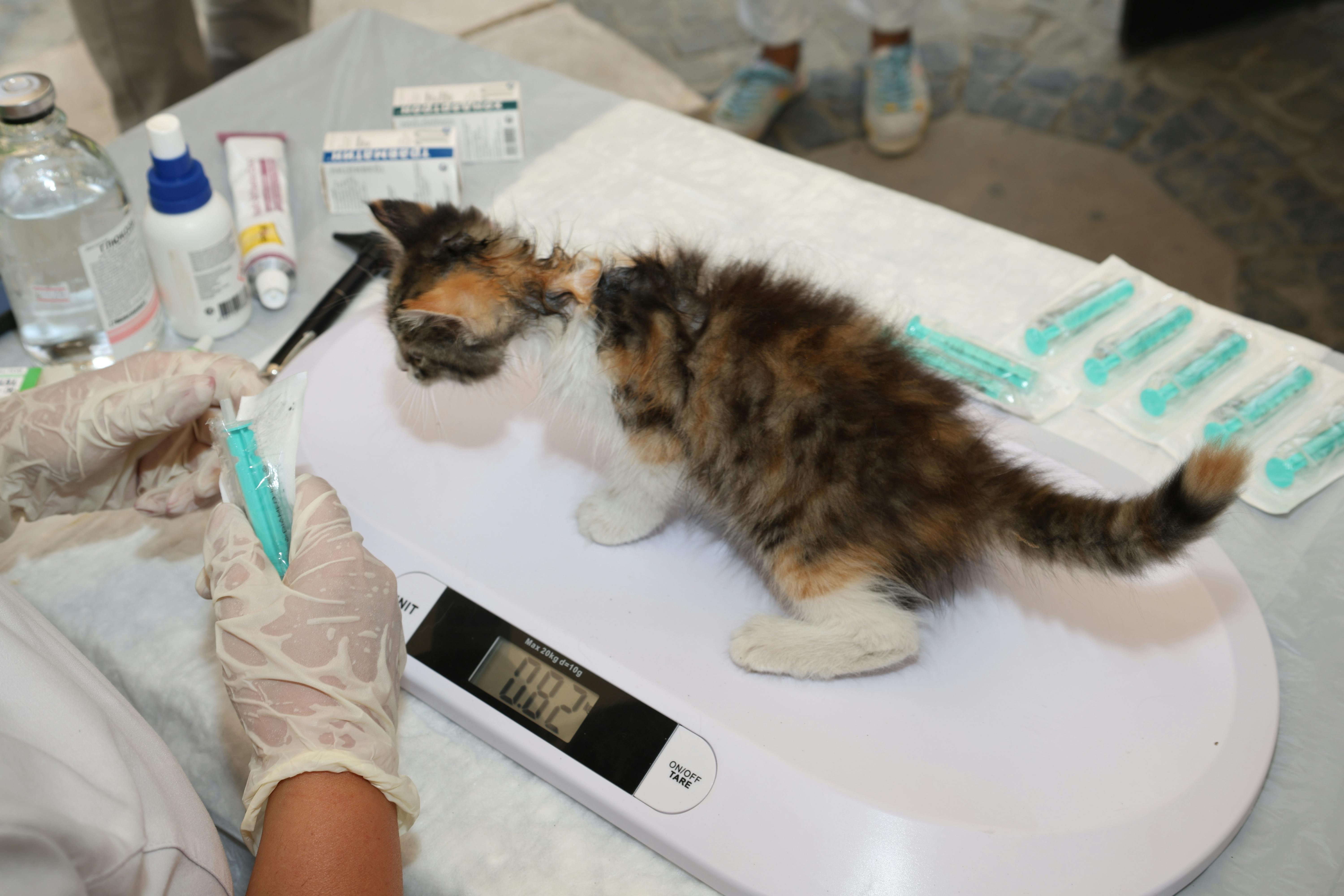 Photo: Tahir / Pexels
How much should a cat weigh?
How much a cat should weigh depends on its breed and frame, so no single weight fits every cat. The Association for Pet Obesity Prevention (APOP) warns that a breed range cannot determine whether an individual pet is underweight or overweight. Frame size, muscle, age, and body composition all matter.
In the PetBudget breed data, adult cat weights run from 5 pounds at the small end to 25 pounds at the large end. Use the chart below to find a starting range. Then confirm it with the body condition test further down.
Cat weight chart by breed
This cat weight table lists adult weight ranges for 14 popular breeds from the PetBudget breed directory. Ranges cover both sexes, and males sit at the top.
| Breed | Adult weight (lb) | Size class |
|---|---|---|
| Devon Rex | 5-9 | Small |
| Cornish Rex | 5-9 | Small |
| Abyssinian | 6-10 | Medium |
| Siamese | 6-12 | Medium |
| Sphynx | 6-12 | Medium |
| Birman | 6-12 | Medium |
| Scottish Fold | 6-13 | Medium |
| Persian | 7-12 | Medium |
| Russian Blue | 7-12 | Medium |
| American Shorthair | 8-15 | Medium |
| British Shorthair | 9-18 | Large |
| Ragdoll | 10-20 | Large |
| Maine Coon | 10-25 | Large |
| Savannah | 12-25 | Large |
A mixed-breed cat has no breed range, so go by body shape. Waltham's growth research covers cats with an adult weight between 2 and 7 kg, which is about 4.4 to 15.4 pounds. That span covers most household cats.
10 to 25 pounds
The normal adult range for a Maine Coon in the PetBudget breed data. The same weight would be severe obesity in a Devon Rex. Look up your cat's breed on the breeds page before you judge the number on the scale.
Is 12 pounds overweight for a cat?
A 12-pound cat is overweight if its frame is small and healthy if its frame is large. Twelve pounds is the top of the range for Siamese, Persian, Russian Blue, Birman, and Sphynx cats in the chart above. It is the middle of the range for a British Shorthair, a Ragdoll, or a Maine Coon.
So the answer to "is 12 pounds overweight for a cat" comes from the body, not the scale. If your cat is a medium-boned shorthair at 12 pounds with no waist, it is carrying extra weight. If it is a long, large-boned cat with a visible waist, the weight can be right.
Is a 15-pound cat too heavy?
A 15-pound cat is too heavy for most medium breeds and normal for many large breeds. In the chart, the American Shorthair tops out at 15 pounds, while the Maine Coon, Ragdoll, British Shorthair, and Siberian can all carry more. A 15-pound cat with ribs you cannot feel is overweight whatever its breed.
The same logic works for a 16, 17, 18, or 19 pound cat. Compare the number with the breed range first. Then check the belly and waist.
The body condition score test
Body condition score (BCS) is the better test than weight. It uses a 9-point scale where 1 is severely underweight and 9 is severely obese, and scores of 4 to 5 are ideal, as Royal Canin explains.
Here is the three-step check:
- Look down at your cat from above. A cat in ideal condition has an obvious waist.
- Look from the side. Ideal cats show a slight abdominal tuck.
- Feel the ribs. In an ideal cat they are not visible but can be easily felt.
A cat scores 6 to 9 when the ribs are hard to feel through fat. The waist is poorly defined or gone, and the belly rounds out with no tuck. If your cat matches that description, book a vet visit before starting a diet.
Kitten weight by age
Kittens gain about 4 ounces per week and reach about 1 pound by 4 weeks old. After that they gain about a pound a month until 6 months, per PetMD's life stage guide. The table applies that rule of thumb.
| Kitten age | Estimated weight |
|---|---|
| 4 weeks | about 1 lb |
| 8 weeks | about 2 lb |
| 12 weeks | about 3 lb |
| 16 weeks | about 4 lb |
| 5 months | about 5 lb |
| 6 months | about 6 lb |
These are estimates from a rule of thumb, not a standard. Large breeds grow faster and finish later. Most kittens reach mature adult weight by 52 weeks, and the majority finish growing by 78 weeks, per the Waltham kitten growth charts.
Waltham advises weighing every 2 to 4 weeks up to 6 months of age, then every 1 to 3 months until the kitten is fully grown. Use the same scale each time. Plot the numbers, and ask your vet if the line flattens or jumps.
How common is cat obesity?
Cat obesity is common. The 2022 APOP survey classed about 61% of US cats as overweight or obese, per Pet Food Industry's report on the survey. The report's headline says owners may misclassify their cats, so many heavy cats go unnoticed at home.
That is why the body condition test matters. A cat that looks normal to its owner can still score a 6 or 7.
What extra weight costs your cat
Extra weight raises the odds of costly disease. A Cornell University study of about 2,000 cats at 31 Northeast veterinary clinics found heavy and obese cats were about 4.5 times more likely to develop diabetes. Obese cats were 7 times more likely to need care for lameness, and twice as likely to die in middle age, per Cornell's report on the study.
The study dates from 1989, so treat the ratios as direction, not as current odds. The costs follow the conditions. Diabetes means insulin, monitoring, and recurring bloodwork. Joint disease means pain medication and extra exams. Those add to a cat's baseline budget, which our cat cost guide puts at $900-$1,600 a year.
Weight also changes what a cat needs to eat. Our cat feeding guide shows daily calories and portions by weight. Overweight cats need fewer calories than their scale weight suggests, so feed for the target weight, not the current one.
Insurance matters here as well. A cat diagnosed with diabetes or arthritis before enrolling may face exclusions. See how waiting periods and pre-existing conditions work.
Use your cat's weight in your budget
Find your cat's breed range in the chart, score its body condition, and weigh it on a schedule. A healthy cat at its target weight costs the least to keep. A heavy cat costs more in food, vet visits, and disease care.
To see what your cat will cost each year, use the PetBudget calculator. To see how a cat's age changes its care, read our cat years to human years guide. Thinking about a large breed? See our Maine Coon kitten price guide.
Frequently asked questions
How much should a cat weigh?
It depends on breed and frame. Breeds in the PetBudget data run from 5 pounds for a Devon Rex to 25 pounds for a Maine Coon. Use body condition score alongside the scale, because a breed range cannot tell you if one cat is overweight.
Is 12 pounds overweight for a cat?
Not always. Twelve pounds is the top of the normal range for a Persian, Siamese, or Russian Blue, but it is mid-range for a British Shorthair or Ragdoll. Check your cat's ribs and waist, because a body condition score of 4 to 5 out of 9 is ideal.
Is a 15-pound cat too heavy?
A 15-pound cat is too heavy for a medium-sized breed and normal for many large breeds. A Maine Coon or Norwegian Forest Cat can be healthy at that weight. A 15-pound domestic shorthair with no visible waist is likely overweight.
How much does a kitten weigh at 12 weeks?
A kitten weighs about 1 pound at 4 weeks and gains roughly a pound a month until 6 months, per PetMD. That puts a 12-week-old kitten near 3 pounds. Individual kittens vary, so track the growth curve with your vet.
How do I know if my cat is overweight?
Look from above for a waist and from the side for a belly tuck. You should feel ribs under a thin fat layer without pressing hard. If you cannot feel the ribs and the belly hangs, your cat scores 6 or higher out of 9 and needs a weight plan.
See your own pet's real numbers.
Run the calculator with your breed, metro area, and care choices for a first-year, annual, and lifetime cost estimate — not a national average.