

Key takeaways
- A neutered adult cat needs about 25 calories per pound per day, so a 10-pound cat eats roughly 260 calories, per the standard resting-energy formula and the MSD Veterinary Manual multiplier of 1.2.
- Kittens need two to three times the calories per pound of adults and eat 3-4 meals a day until about 6 months, while adults do well on two meals spaced 8-12 hours apart.
- About 61% of U.S. cats are overweight or obese, so weigh portions, count treats within 10% of daily calories, and re-check your cat's body condition every few months.
A neutered adult cat needs about 25 calories per pound of body weight per day. A healthy 10-pound cat eats roughly 260 calories, which is about 3.5 cans of wet food or 0.65 cup of typical dry food. This guide answers how much should I feed my cat at every age, with charts by weight, wet and dry portions, and the mistakes that cause weight problems.
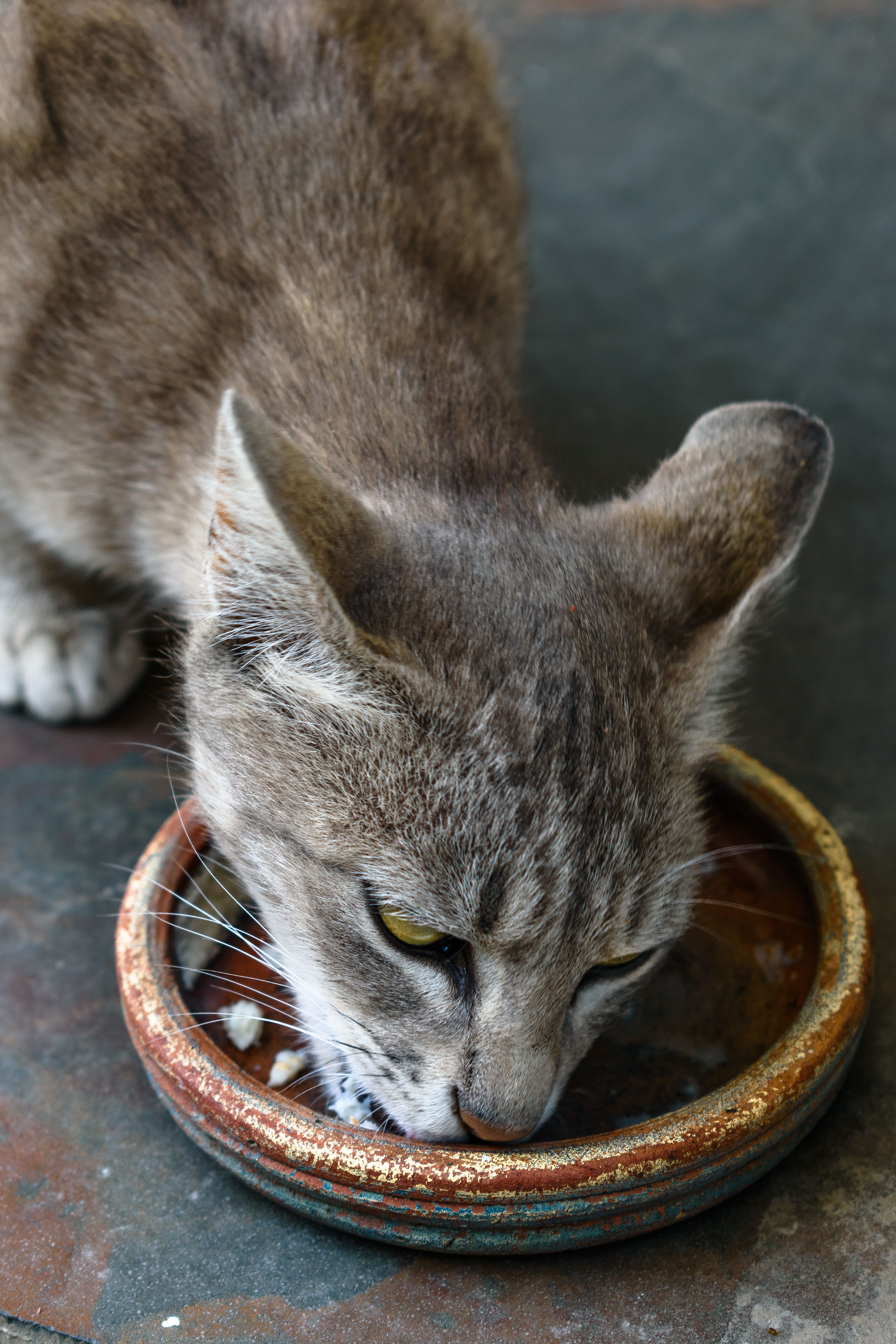 Photo: chalta-phirta / Pexels
Think of this as the ultimate cheat sheet for the food dish, with one section for every life stage. Feeding is also one of the biggest line items in cat ownership. Our how much does a cat cost guide puts first-year food at $250-$450. Getting portions right keeps that number down and keeps your cat at a healthy weight.
How many calories in a cat's daily diet?
Veterinarians set a cat's daily calories in two steps. First they calculate the resting energy requirement, or RER, which is 70 times body weight in kilograms raised to the 0.75 power. Then they multiply it by a life-stage factor. How many calories in a cat's day comes down to that second number.
The MSD Veterinary Manual energy table lists these multipliers for healthy cats:
| Cat type | Multiplier of RER |
|---|---|
| Neutered adult | 1.2 |
| Intact adult | 1.4 |
| Obesity-prone adult | 1.0 |
| Kitten | 2.5 |
About 260 calories a day
is what a neutered 10-pound adult cat needs, using the MSD Veterinary Manual's 1.2 multiplier. PetMD lists the same 250 calories for that weight. See what feeding your cat costs over a year in the PetBudget calculator.
The MSD manual adds that any calorie calculation is only a starting point. Your cat's weight over the next four to six weeks is the real test. If it holds steady, the number is right.
What affects how much a cat eats
Four factors move a cat's calorie needs up or down from the chart. Know them before you trust any single number.
- Neutering. Spayed and neutered cats burn fewer calories than intact cats. PetMD lists 250 calories for a neutered 10-pound cat and 350 for an intact one.
- Age. Kittens need two to three times the calories per pound of an adult, per PetSafe.
- Activity. An indoor cat that naps most of the day needs less than an active outdoor cat.
- Body condition. Cats prone to weight gain are fed closer to their resting needs. Chewy lists 216 calories for a weight-prone 10-pound cat versus 260 for a typical neutered one.
Health also matters. Kidney disease, diabetes, and dental pain all change appetite and calorie needs. A cat that suddenly eats much more or less than usual needs a vet visit, not a new chart.
Feeding guidelines by age
The right amount and the right schedule both change as a cat grows. Kittens eat the most per pound, adults settle into a steady routine, and seniors often need smaller, more frequent meals.
How much should I feed my kitten
Kittens up to 6 months old eat 3-4 small meals a day, per PetSafe's feeding frequency guide. Their stomachs are tiny, so small meals work better than large ones. At about 6 months, most kittens move to 2 meals a day.
Kitten calorie needs are 2.5 times the resting requirement. Using that multiplier, here is what a growing kitten needs. The totals are estimates, and a kitten food label gives the exact serving.
| Kitten weight | Approximate calories per day |
|---|---|
| 2 lb | 165 |
| 4 lb | 275 |
| 6 lb | 370 |
| 8 lb | 460 |
Whisker's feeding chart lists 320 calories for a 5-pound kitten, which matches this math. Feed kitten food until about 12 months, since it carries more protein and fat than adult food.
How much to feed an adult cat
Healthy adult cats do well on at least two meals a day, about 8 to 12 hours apart, per PetSafe. The daily amount follows the weight chart in the next section. Most adults land between 180 and 350 calories a day, depending on size.
Many owners keep a bowl of dry food full all day. That works for lean cats with steady appetites. For cats that gain weight, measured meals are safer, because a full bowl hides how much is really eaten.
How much to feed a senior cat
Senior cats, from about 7 years old, eat 2-3 smaller meals a day, and cats over 10 may eat 2-4 small, easy-to-digest meals, per PetSafe. Whisker lists 180-220 calories a day as a common senior range.
Weight can drift either way in older cats. Some gain from a slower metabolism, and others lose weight from dental pain or kidney trouble. Weigh your senior cat monthly and call your vet about any change of 10% or more. Our guide to how often to take a dog or cat to the vet covers the twice-a-year senior schedule.
Cat feeding charts
These charts turn the formulas into numbers you can use at the food dish. Every figure is a starting point, and your cat's weight trend decides whether to adjust.
How much to feed a cat chart by weight
This how much to feed a cat chart by weight uses the neutered-adult multiplier of 1.2. It is also a simple cat feeding chart for the question of how much does a cat eat a day.
| Cat weight | Calories per day | Weight-prone cat | Weight-loss plan |
|---|---|---|---|
| 5 lb | 155 | 131 | 105 |
| 8 lb | 220 | n/a | n/a |
| 10 lb | 260 | 216 | 173 |
| 12 lb | 300 | n/a | n/a |
| 15 lb | 355 | 295 | 236 |
| 20 lb | 440 | 367 | 293 |
The first column comes from the RER formula above. The weight-prone and weight-loss columns come from the Chewy cat feeding chart. Use the weight-loss column only under a vet's guidance, since your vet should set the target weight.
Use your cat's ideal weight, not its current weight, when your cat is overweight. A 16-pound cat with an ideal weight of 12 pounds should eat about 300 calories, not 380.
Cat feeding guide wet and dry
A cat feeding guide wet and dry comes down to one idea: calories are calories. Convert your cat's daily total into cans or cups using the label on your food.
PetMD suggests splitting calories equally for a mixed diet. A 250-calorie cat gets 125 calories of wet food and 125 of dry. Here is how that looks for a 10-pound cat needing about 260 calories.
| Feeding plan | Wet food | Dry food (400 cal per cup) |
|---|---|---|
| All wet | 3.6 cans (73 cal each) | none |
| Half and half | 1.8 cans | about 1/3 cup |
| All dry | none | about 2/3 cup |
The 73-calorie can is a real example. Chewy lists Purina Pro Plan White Meat Chicken at 73 calories per 3-ounce can. The 400-calorie cup is an example figure, and real dry foods range widely. Read the "kcal per cup" line on your bag.
Wet food adds water as well as calories, which helps cats that drink little. Our guide on how much water a cat should drink a day explains why.
How much to feed a cat for specific breeds
Breed changes the chart less than you might expect. A cat's calories depend mainly on its weight, and breeds differ mostly in how heavy they get. A Maine Coon at 15 pounds eats like any 15-pound cat, about 355 calories, while a 9-pound domestic shorthair eats about 235.
Check your breed's typical size on its page, such as Maine Coon or British Shorthair. Then use the weight chart above. Large breeds also cost more to feed, which the PetBudget calculator shows by breed.
Using a cat food calculator
A cat food calculator does the same three steps you can do by hand: find a calorie target, read the food's calorie count, and divide. Doing it once yourself shows you what any online tool is doing.
How to calculate daily calorie intake
Follow these steps for an adult cat.
- Weigh your cat on a bathroom scale. Weigh yourself holding the cat, then alone, and subtract. Use kilograms by dividing pounds by 2.2.
- Find the RER. Multiply 70 by your cat's weight in kilograms raised to the 0.75 power. A 10-pound cat is 4.5 kilograms, which gives an RER of about 218.
- Apply the life-stage multiplier. Multiply by 1.2 for a neutered adult. That gives about 260 calories.
- Read the food label. Find the calories per can or per cup.
- Divide. Daily calories divided by calories per serving gives servings per day.
- Adjust. Weigh your cat after a month and add or remove about 10% if the weight is drifting.
The simple rule of thumb is 25 to 35 calories per pound, per PetMD. The lower end suits indoor, neutered adults. The higher end suits active cats. PetSafe uses 20 calories per pound of ideal weight for a healthy indoor adult.
How much wet food to feed a cat calculator
A how much wet food to feed a cat calculator uses one formula: daily calories divided by calories per can. Cans differ a lot, so use the label.
To answer how many grams of cat food per day, convert the can size. A 3-ounce can is about 85 grams, so a 73-calorie can holds about 0.86 calories per gram. Divide your cat's calories by that figure.
| Cat weight | Daily calories | Wet food cans (73 cal) | Grams per day |
|---|---|---|---|
| 5 lb | 155 | 2.1 | about 180 |
| 10 lb | 260 | 3.6 | about 300 |
| 15 lb | 355 | 4.9 | about 415 |
| 20 lb | 440 | 6.0 | about 510 |
Results change with the food. A richer pâté with more calories per can means fewer grams. A watery stew means more.
Common mistakes in feeding cats
Most feeding problems come from guessing portions, not from the type of food. Two mistakes cause most of the trouble: giving too much and not noticing it.
Overfeeding vs underfeeding
Overfeeding is the far more common problem. The Association for Pet Obesity Prevention's 2022 survey found that 61% of cats examined by U.S. veterinary professionals were overweight or had obesity. A University of California, Davis study of 9,062 cats, cited by PetMD, found 41% were obese.
Common causes of overfeeding include:
- Eyeballing portions instead of measuring them
- Several family members each feeding the cat
- Treats that add up quietly
- Refilling a dry food bowl without tracking the total
PetMD says treats should never make up more than 10% of daily calories. For a 260-calorie cat, that is 26 calories, or a small handful of treats.
Underfeeding is rarer but real. Signs include visible ribs and hip bones, a drop in energy, and constant begging that goes beyond habit. Never cut calories sharply without a vet's plan. A cat that stops eating for a day or more needs a vet visit, since appetite loss in cats can signal illness.
Recognizing signs of obesity in cats
Veterinarians score cats on a 9-point body condition scale, per Royal Canin's body condition guide. A score of 4-5 is ideal, 6-7 is overweight, and 8-9 is obese. You can check at home in under a minute.
- Feel the ribs. Run your hands along the sides of the chest. At an ideal weight you can feel them easily under a thin layer of fat.
- Look from above. An ideal cat has a visible waist behind the ribs.
- Look from the side. The belly should tuck up behind the ribcage.
If you must press hard to find the ribs, or the body looks like a rounded oval from above, your cat is carrying extra weight. Many owners miss it. The APOP report notes that many owners of overweight pets see their pet's condition as normal or ideal. A vet can confirm the score and set a target weight.
The stakes are real for your wallet as well as your cat. Chewy notes that extra weight raises the risk of diabetes and high blood pressure, which mean lifelong vet bills. See our vet visit cost guide for typical exam fees.
How much it costs to feed a cat
Cats are a big and growing part of American pet ownership. The 2025 APPA National Pet Owners Survey found that 53 million U.S. households own a cat, per Pet Food Industry. Each of those owners is deciding how much to feed, and every scoop has a price.
Food runs $250-$450 in a cat's first year, per our cat cost guide, and it sits inside total yearly upkeep of $900-$1,600. A cat at a healthy weight also avoids the extra vet visits that come with obesity-related illness. Add your cat's breed to the PetBudget calculator for a full-year estimate, or use the breed compare tool to see how two breeds differ.
The bottom line
How much should I feed my cat? Start with about 25 calories per pound for a neutered adult, feed kittens two to three times that per pound, and hold seniors near 180-220 calories a day. Measure meals, count treats within 10% of calories, and check your cat's ribs and waist every few months. Adjust by about 10% when the weight drifts, and ask your vet to confirm the target weight.
Frequently asked questions
How much should I feed my cat per day?
A neutered adult cat needs about 25 calories per pound of body weight per day. A 10-pound cat eats roughly 260 calories, which is about 3.5 cans of 73-calorie wet food or around 0.65 cup of a 400-calorie-per-cup dry food. Check the calorie count on your own food's label.
How much wet food should I feed my cat?
Divide your cat's daily calories by the calories in one can. A 10-pound adult needing 260 calories eats about 3.6 cans of a 3-ounce, 73-calorie wet food, or roughly 300 grams. Wet food labels vary, so the label calorie count always wins over a general chart.
Should I feed my cat wet food, dry food, or both?
Both work if the total calories match your cat's needs. PetMD suggests splitting calories evenly, so a 250-calorie cat gets 125 calories of wet food and 125 of dry. Wet food adds water, and dry food is cheaper per day and easier to leave out.
How many times a day should I feed my cat?
Kittens under 6 months need 3-4 small meals a day, and 6-12 month olds need 2. Healthy adults should eat at least twice a day, about 8 to 12 hours apart, per PetSafe. Seniors often do best on 2-3 smaller meals.
How do I know if my cat is overweight?
Run your hands along your cat's ribs. At an ideal body condition score of 4-5 on the 9-point scale, you can feel the ribs easily and see a waist from above. If you must press hard to find the ribs, your cat is likely carrying extra weight.
See your own pet's real numbers.
Run the calculator with your breed, metro area, and care choices for a first-year, annual, and lifetime cost estimate — not a national average.