
Key takeaways
- The Small and Large Munsterlander are two separate German gundog breeds from the same region, not size variants: the Large was developed from different breeding stock and is not related as the names suggest.
- The Small is brown and white at about 38 to 58 pounds, the Large is black and white at about 65 pounds, and PetBudget's model puts them at $2,241 and $2,654 a year to keep.
- Over a lifetime the Large costs about $34,293 against $31,388 for the Small, a $2,905 gap that comes mostly from food and grooming.
The Small and Large Munsterlander are two different German bird dogs that share a region and a name, not a small and large version of one breed. The Small is brown and white and weighs about 38 to 58 pounds. The Large is black and white and weighs about 65 pounds. They also differ in cost: PetBudget's model puts the Small at $2,241 a year and the Large at $2,654.
The large munsterlander vs small munsterlander question comes down to size, coat color, temperament and yearly cost, all compared below. If you are choosing between them, or trying to work out which one a breeder is selling, this guide compares them side by side. Both have their own pages with whole-breed numbers: Small Munsterlander and Large Munsterlander.
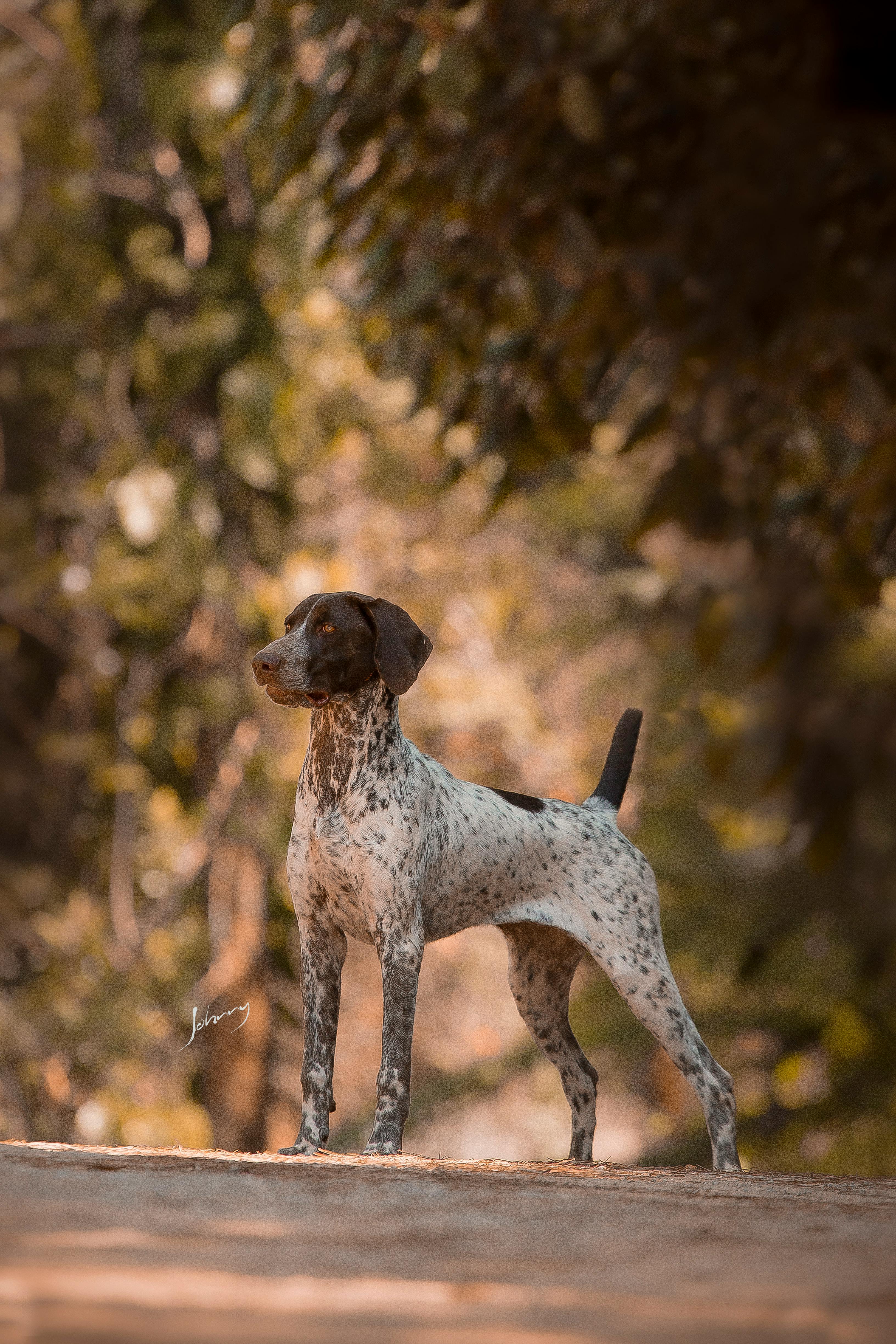 Photo: Mariana Saliola / Pexels. A Braque Francais gun dog, shown as a similar continental pointing type; it is not a Munsterlander.
Are the Small and Large Munsterlander related?
No. Both breeds come from the area around Munster, Germany, but they were built from different stock. Wikipedia's Small Munsterlander entry says the Large Munsterlander "was developed from different breeding stock and is not related as the names would suggest."
The Large Munsterlander has a clear lineage of its own. According to Wikipedia's Large Munsterlander entry, it became a separate breed after the German Longhaired Pointer's breed society removed black-and-white coloring from its standard. A new society for black-and-white longhaired pointers formed in 1919, the breed was recognized in 1922, and the FCI accepted it in 1954.
For a buyer, the practical meaning is that you cannot assume traits transfer. A breeder who says "Munsterlander" without a size needs to be asked which breed they mean, and a puppy's papers should name it.
How do they differ in size, coat and look?
The Large is taller, heavier and black and white. The Small is lighter and brown and white. Using the figures in the two Wikipedia entries:
| Trait | Small Munsterlander | Large Munsterlander |
|---|---|---|
| Height, males | 20.5 to 22 inches | 24 to 26 inches |
| Height, females | 19.75 to 21.25 inches | 23 to 26 inches |
| Weight | 38 to 58 pounds | About 65 pounds |
| Coat color | Brown patches on a white or ticked white background | Black and white; the head is usually mostly black |
| Coat | Medium length, thick, straight or slightly wavy | Dense coat that picks up burrs |
PetBudget's breed data lists the Small at 30 to 40 pounds and the Large at 55 to 71 pounds for modeling. Those are narrower than the Wikipedia range for the Small, so the model sizes the Small slightly leaner than the breed's full range. Plan for the number your own dog's parents suggest.
How do their temperaments and jobs compare?
Both are versatile hunting dogs that need hard daily exercise. The Small Munsterlander article describes the Small as extremely intelligent, trainable and attentive, with a strong prey drive and a need for an hour or more of challenging exercise a day. It adds that Smalls are affectionate indoors but not suited to kennel life.
The Large is described by the FCI standard as athletic, intelligent, noble and elegant, and as an all-round gun dog that works on land and especially in water. A UK source quoted by one search result says the Small is more intense and independent than the calmer Large, but that is one view, not a standard.
Either dog in a household that wants a quiet pet is a mismatch. Their needs are the same type: a job, long runs, training and company. If you will not hunt, budget for dog sports, scent work or long daily hikes, and expect a bored dog to cost you chewed furniture.
Which one is easier to find in the United States?
The Small is rare but established, and the Large is the newer arrival. Wikipedia reports the Small at around 2,000 dogs in the U.S., lists it as an American Kennel Club Foundation Stock Service breed and says the United Kennel Club recognizes it as a gun dog. Wikipedia's Large Munsterlander page says the AKC recognized that breed in 2023.
Rarity affects the price and the search. Expect waiting lists, a possible long drive or flight for the puppy, and a breeder who asks you about your plans for the dog. The PetBudget model uses $1,000 for the Small and $1,100 for the Large as planning prices for a puppy, and real quotes can run above or below that.
What does each breed cost to keep?
The Large costs about $413 a year more to keep, and the difference comes from food, grooming and a few other lines. The table uses PetBudget's ongoing-year figures for each breed.
| Annual line | Small Munsterlander | Large Munsterlander |
|---|---|---|
| Food | $497 | $772 |
| Vet care | $660 | $665 |
| Grooming | $195 | $312 |
| Insurance | $749 | $744 |
| Supplies and toys | $140 | $161 |
| Total per year | $2,241 | $2,654 |
The vet and insurance lines are almost identical, so health spending is not the deciding factor in the model. Food and grooming are. A Large that weighs about 65 pounds eats more, and a dense coat that collects burrs costs more to keep tidy.
The insurance figure starts from the average U.S. dog plan in NAPHIA's State of the Industry highlights, which is $836 a year. Both breeds come in lower after PetBudget's size and risk adjustments. Your own quote will vary by age, ZIP code and deductible.
$2,905
Lifetime cost gap between the two breeds in PetBudget's model: $34,293 for a Large Munsterlander against $31,388 for a Small. The Large costs more even with its one-year-shorter modeled lifespan. See your own figure in the calculator.
What does the first year cost for each?
The Large costs about $603 more in its first year. The first year is $4,496 for the Small and $5,099 for the Large in PetBudget's model, and each includes the puppy, setup, vaccines, training and a year of recurring care.
| First-year line | Small Munsterlander | Large Munsterlander |
|---|---|---|
| Purchase or adoption | $1,000 | $1,100 |
| Initial vet visit and vaccinations | $660 | $700 |
| Starter supplies | $475 | $546 |
| Training classes | $260 | $260 |
| Recurring care (food, vet, grooming, insurance) | $2,101 | $2,493 |
| Total | $4,496 | $5,099 |
Recurring care in the first year includes food, vet care, grooming and insurance but not the supplies-and-toys line, which the model charges from year two. A gundog that needs a crate, a long line and training gear pushes the supplies line up, so read the figures as a floor.
What health costs do both breeds share?
The main shared cost is hip dysplasia, and ear care is the second. The breed article on the Small says breeders screen for hips with OFA or PennHIP, and calls the breed "robustly healthy" with rare issues apart from dry skin in cold climates and water in the ears after swimming.
Neither breed is health-free. If a hip does need surgery, MetLife's hip dysplasia surgery guide gives a range of $1,200 to $6,000, and PetBudget's breed data uses $4,100 for the Large and $5,000 for the Small as typical figures. Iowa State University's hip replacement page lists $7,000 to $9,000 per hip for a full replacement.
Wet ears are the second recurring item. Hanging ears that stay damp after swimming invite infections, so a drying and cleaning routine saves visits. A dog that swims often needs the routine every time.
How much should you keep in reserve?
Keep $3,000 for a Small Munsterlander and $4,000 for a Large. Those are the reserves in PetBudget's model, based on MetLife's 2025 survey of 1,000 pet owners, which found that 15% had spent $3,000 or more on an unexpected vet bill and that 90% had no savings set aside for pets.
Either reserve covers a single orthopedic surgery at the lower end of the range. It will not cover a hip replacement. Insurance is the alternative, and the pet insurance versus emergency fund comparison shows where each approach wins.
How is each lifetime cost built?
Each lifetime total is the first year plus the ongoing years, and the arithmetic shows why a shorter life does not make the Large cheaper. The Small's $31,388 is $4,496 plus 12 years at $2,241. The Large's $34,293 is $5,099 plus 11 years at $2,654.
The Large loses one year of care and still costs $2,905 more, because every one of its years costs $413 extra. If you want to close the gap, the levers are food and grooming: buy kibble in larger bags, brush at home and learn nail and ear care. The dog food cost guide breaks down what a bag costs by dog size.
How do they compare with similar hunting breeds?
Both land in the same cost band as other versatile gundogs. The table lists PetBudget's modeled yearly figures for two comparable hunting breeds next to the two Munsterlanders.
| Breed | Weight range in the model | Annual cost | Lifetime cost |
|---|---|---|---|
| Small Munsterlander | 30 to 40 pounds | $2,241 | $31,388 |
| Large Munsterlander | 55 to 71 pounds | $2,654 | $34,293 |
| Pudelpointer | 45 to 70 pounds | $2,586 | $36,063 |
| Wirehaired Vizsla | 45 to 65 pounds | $2,562 | $35,751 |
The Small is the cheapest of the four, and the Large sits at the top of the annual range. The Pudelpointer and Wirehaired Vizsla have higher lifetime totals because the model gives them a 13-year lifespan against the Large Munsterlander's 12.
Which Munsterlander should you choose?
Choose the Small if you want a mid-size, brown-and-white dog with a lower food bill. Choose the Large if you want a taller dog, a black-and-white coat and a calmer reputation. Both need a job and an hour or more of hard exercise daily.
Run through this checklist before you commit:
- Confirm the breed and size name on the puppy's papers.
- Ask for the parents' hip results from OFA or PennHIP.
- Ask how the parents are used: field, trial or pet only.
- Get a written quote for puppy insurance on your ZIP code.
- Plan the exercise: at least an hour a day, and a way to burn off energy on rainy days.
If a Munsterlander is too rare to find, the Pudelpointer and the Wirehaired Vizsla are comparable versatile hunting breeds with more US breeders.
Frequently asked questions
Do Munsterlanders shed a lot?
Both shed moderately. PetBudget's breed data rates shedding at 3 out of 5 for each, and the longer, denser Large coat needs more brushing and trimming. Plan on weekly brushing and a groomer for the occasional tidy-up.
Are Munsterlanders good family dogs?
They can be, if the family supplies hard daily exercise and training. Wikipedia describes the Small as affectionate indoors but not suited to kennel life. Neither is a low-maintenance pet.
How long do Munsterlanders live?
PetBudget's model uses 13 years for the Small and 12 for the Large, with ranges of 12 to 14 and 12 to 13 years. Wikipedia's entries do not state a lifespan, so treat the figures as modeled estimates.
Can a Munsterlander live in an apartment?
It is possible but hard. Both breeds need an hour or more of hard exercise a day and a mental job, so a small apartment works only if you commit to long outings every day.
Frequently asked questions
Are the Small and Large Munsterlander the same breed?
No. Both come from the Munster region of Germany, but Wikipedia's breed entries say the Large Munsterlander was developed from different breeding stock and is not related to the Small as the names would suggest.
How big is a Small Munsterlander?
Males stand about 20.5 to 22 inches at the withers and females about 19.75 to 21.25 inches, with a weight range of 38 to 58 pounds, according to Wikipedia's breed entry.
Is the Large Munsterlander recognized by the AKC?
Wikipedia says the American Kennel Club recognized the Large Munsterlander in 2023. It lists the Small Munsterlander as an AKC Foundation Stock Service breed that the United Kennel Club recognizes as a gun dog.
Which Munsterlander costs more to own?
The Large. In PetBudget's model it costs $2,654 a year against $2,241 for the Small, mainly because it eats more and has a longer coat to groom.
See your own pet's real numbers.
Run the calculator with your breed, metro area, and care choices for a first-year, annual, and lifetime cost estimate — not a national average.
Comments
Comments are moderated before they appear. Constructive questions, corrections and first-hand pet cost experiences are welcome.
Verified Dialogue
Sort by: Chronological (earliest)Loading comments…