

Key takeaways
- The Burgos Pointer, or Perdiguero de Burgos, is a 55 to 66 pound Spanish hunting dog that PetBudget models at $2,480 a year and $34,685 over 13 years.
- No breed-specific bloat rate exists, but the ACVS says about 1 in 5 at-risk dogs without a preventive gastropexy develop bloat, and the add-on costs $300 to $400 at a spay or neuter versus $2,000 to $7,000 for emergency surgery.
- A gastropexy pays for itself in expectation once a dog's bloat risk passes about 7 percent, so the decision depends on how many risk factors your individual dog has.
The Burgos Pointer is a large, rare Spanish hunting dog whose most expensive risk is a stomach that twists in a few hours. The breed has no published bloat rate, so the useful question is not "is it prone?" but "what does a preventive surgery cost compared with the emergency it prevents?" This guide runs that math, then covers the breed's background, import rules and yearly cost.
The modeled breed numbers sit on the Burgos Pointer page.
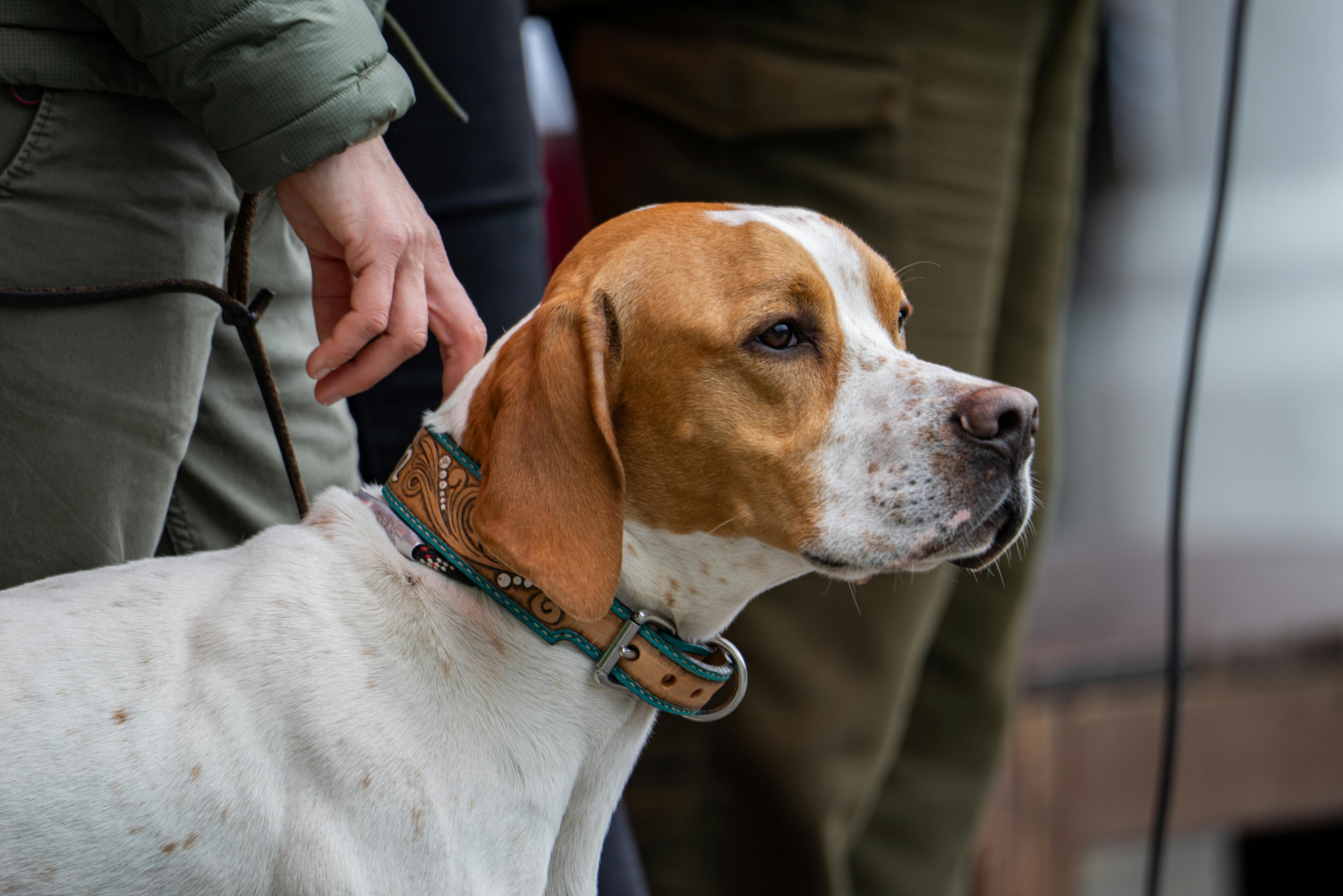 Photo: Jiri Dockal / Pexels. A pointer dog with its handler, shown as a similar hunting type; it is not a Burgos Pointer.
What is a Burgos Pointer?
The Burgos Pointer is a Spanish pointing dog from Castile and León, especially the province of Burgos. Wikipedia's Burgos Pointer entry dates it to the 16th century and says it likely descends from the Sabueso Español and the Pachón Navarro. In Spanish it is the Perdiguero de Burgos, and some English pages call it the Burgalese Pointer or the Burgos pointing dog.
It is used in the countryside for hares, rabbits and birds. Wikipedia describes a gentle, quiet dog that is rarely startled, learns easily and is very good with children. It adds that the breed does not do well in urban settings and needs daily exercise and open space.
The entry gives these physical details.
| Trait | Burgos Pointer |
|---|---|
| Height | 24 to 26 inches (males), 23 to 25 inches (females) |
| Weight | 55 to 66 pounds |
| Coat | Short, bushy and smooth; brown or brown with white spots |
| Build | Robust and square-built, with long ears and a double chin |
| Tail | Usually docked by about a third in its home country |
PetBudget's breed data adds a 90-minute daily exercise figure and an energy rating of 4 out of 5. That is a working dog's schedule, not a weekend dog's.
Is the Burgos Pointer a rare breed?
Yes, and the home registry says it is under pressure. Wikipedia reports that in 2026 the Spanish kennel club, the Real Sociedad Canina de España, listed the Burgos Pointer among sixteen Spanish breeds it considers "vulnerable" for the period from May 1, 2025 to April 30, 2026. The page gives no registration numbers, so I cannot say how many dogs that means.
I found no AKC recognition and no US breeder directory. A US buyer should expect to deal with a Spanish breeder, and should read our guide to how a rare-breed import works for a Dutch gundog because the steps are the same.
Does the Burgos Pointer get bloat?
Bloat, or gastric dilatation-volvulus, is on the breed's health list in PetBudget's data, but no study I found measures it in this breed. The risk comes from the dog's type. The Purdue University veterinary lab's canine bloat newsletter says dogs with narrow, deep chests are at increased risk. Wikipedia's description of the Burgos Pointer is "robust and square-built," which is not a classic narrow-chested outline.
I would not call the breed high-risk or low-risk. The honest position is that a 55 to 66 pound athletic dog sits in the size range where vets raise the topic, and the individual dog's family history matters more than the breed label. The American College of Veterinary Surgeons lists these as reasons to consider a preventive gastropexy: a large or giant breed, a deep chest, an anxious temperament and a close relative that has had bloat.
Our dog bloat surgery cost guide covers the symptoms and the emergency itself. This post focuses on the decision before it happens.
What does bloat surgery cost compared with prevention?
Emergency bloat surgery costs several times more than a preventive gastropexy. Embrace Pet Insurance's gastropexy guide gives three price bands.
| Procedure | Typical cost |
|---|---|
| Gastropexy added to a spay or neuter | $300 to $400 extra |
| Standalone gastropexy | $800 to $3,000, with laparoscopy near the top |
| Emergency bloat surgery with gastropexy | $2,000 to $7,000 or more |
PetBudget's breed data uses $2,000 to $7,500 for the emergency, with a midpoint of $4,750, from a MetLife Pet Insurance range. The same Embrace guide cites a 2020 study in the Journal of Veterinary Emergency and Critical Care. About 60 percent of dogs with bloat survived, counting those put down before surgery, and about 80 percent of dogs that had the surgery survived.
When does a gastropexy pay for itself?
A gastropexy breaks even once a dog's chance of bloat passes about 7 percent. The calculation compares the $350 midpoint of the add-on with the $4,750 midpoint of the emergency: $350 divided by $4,750 is 0.074.
The ACVS says bloat "can occur in 1 out of every 5 dogs that are at risk and do not undergo a prophylactic gastropexy." That is a 20 percent chance in a group the ACVS defines as at risk. The expected emergency cost for that group is 20 percent of $4,750, or $950. Against that, the add-on costs $350.
| Dog's bloat chance | Expected emergency cost | Add-on at neuter | Cheaper choice |
|---|---|---|---|
| 5 percent | $238 | $350 | No gastropexy |
| 7.4 percent | $350 | $350 | Break-even |
| 10 percent | $475 | $350 | Gastropexy |
| 20 percent | $950 | $350 | Gastropexy |
Three limits apply, and I would state them plainly to anyone reading this table.
- The 20 percent figure belongs to dogs the ACVS calls at risk. A Burgos Pointer without risk factors may sit far below it.
- The calculation prices money only. It leaves out the fact that about 2 in 10 treated dogs still die, and that bloat is a fast, painful emergency.
- The $350 add-on applies only when the dog is already under anesthesia for a spay or neuter. A standalone procedure at $1,900 shifts the break-even to about 40 percent.
The practical rule is this. If your dog is neutered or spayed anyway and your vet has flagged any risk factor, the add-on is cheap enough to say yes. If the surgery would be standalone, the decision needs a real risk factor behind it.
Open or laparoscopic: what changes for a pointer owner?
The technique changes recovery more than it changes the benefit. The ACVS describes an open gastropexy as a midline incision "usually 8-12 inches in length," with the stomach sutured to the body wall. A laparoscopic version uses 2 to 3 small incisions under 1.5 inches and a camera, and the ACVS says it brings "less pain and a shorter recovery."
Both need 10 to 14 days of confinement and restricted exercise afterward. For a dog with a 90-minute daily exercise need, that fortnight is the real cost, and it is why many owners schedule the add-on with the neuter instead of choosing a separate date. Whether it pays off for your dog depends on that timing and on the risk factors above.
Which bloat risk factors can you check yourself?
Check five factors before you talk to the vet. Embrace names first-degree relatives with bloat, fast eating, a nervous temperament and being fed once a day as risk factors, and the ACVS adds a deep chest.
- Ask the breeder whether any parent, sibling or grandparent has had bloat.
- Split the daily food into two meals instead of one.
- Use a slow-feeder bowl if the dog gulps.
- Keep hard exercise away from mealtimes.
- Ask your vet to measure chest depth against width at the first checkup.
Recurrence data makes the surgical case clearer. The Embrace guide cites a Veterinary Evidence study in which bloat recurred in under 5 percent of dogs with a gastropexy and over 50 percent of dogs without one. After a first episode, the pexy is close to non-negotiable.
What does a Burgos Pointer cost to keep?
A Burgos Pointer costs about $2,480 a year in PetBudget's model, or $207 a month, after a first year of $4,925. The model uses a $1,100 puppy price, which is an estimate and not a quote. Import costs are extra.
| Annual line | Burgos Pointer |
|---|---|
| Food | $732 |
| Vet care | $700 |
| Grooming | $78 |
| Insurance | $809 |
| Supplies and toys | $161 |
| Total per year | $2,480 |
The short coat keeps grooming at $78, the lowest line, so the money goes to food and insurance. The food line assumes a lean working appetite for a dog of about 70 pounds.
$34,685
Modeled lifetime cost of a Burgos Pointer over 13 years, before import fees and before any bloat surgery. Adjust the inputs in the calculator.
How does it compare with other pointing breeds?
The Burgos Pointer costs slightly less than the German Shorthaired Pointer and the Weimaraner, and about the same as the English Pointer. The short coat keeps its grooming line low, and the model prices all five breeds within about 17 percent of each other.
| Breed | Weight | Annual cost | Lifetime cost |
|---|---|---|---|
| Vizsla | 44 to 60 pounds | $2,416 | $33,853 |
| Burgos Pointer | 55 to 66 pounds | $2,480 | $34,685 |
| Pointer | 45 to 75 pounds | $2,492 | $34,841 |
| German Shorthaired Pointer | 45 to 70 pounds | $2,685 | $34,665 |
| Weimaraner | 55 to 90 pounds | $2,822 | $36,309 |
You can open each breed on the breed comparison page. The Weimaraner page is the useful one for bloat, since the breed appears on Embrace's list of most-affected breeds.
What are the CDC rules for a dog from Spain?
Spain did not appear on the CDC's high-risk list for dog rabies in the versions I checked, but the CDC lists the Spanish cities Ceuta and Melilla separately. A dog that has stayed only in low-risk places follows the simpler 2024 rules, which the AKC summarized.
- The dog must be older than 6 months and microchipped.
- You complete a free CDC Dog Import Form online, and the receipt lasts 6 months.
- The dog must look healthy on arrival.
Confirm the current list on the CDC's Dog Importation Navigator before you book. A dog spending any time in a listed country in the prior 6 months follows the stricter rules.
Is a Burgos Pointer right for you?
The Burgos Pointer suits a rural or large-yard owner who wants a calm, hardworking pointing dog and accepts a long search. It does not suit an apartment, a first-time owner who needs a breed with US trainers and vets who know it, or a buyer who needs a dog this season.
If the wait is the problem, the easier alternatives are the Vizsla and the Pointer in the table above. Both cost within about 3 percent a year, and both have far more US breeders. For a full first-year and lifetime comparison, use our calculator.
What is the bottom line?
A Burgos Pointer costs about $2,480 a year, and the one budget line to plan in advance is a gastropexy. If your vet flags a risk factor and your dog is already having a spay or neuter, the $300 to $400 add-on is the cheaper bet. If not, keep the $4,000 large-dog reserve that PetBudget models.
No veterinarian reviewed these modeled figures. Use the break-even table to frame the question, then ask your vet about your own dog's chest, family history and temperament.
Frequently asked questions
What is a Burgos Pointer?
A Burgos Pointer is a Spanish pointing dog from the province of Burgos in Castile and León, also called the Perdiguero de Burgos. It is a robust, square-built hunting dog of 55 to 66 pounds with a short coat, long ears and a double chin.
Is the Burgos Pointer prone to bloat?
I found no published bloat rate for the breed. It is a large, athletic dog, and deep chests and large size are general risk factors, so many vets would discuss a preventive gastropexy.
How much does a gastropexy cost?
Embrace Pet Insurance puts a gastropexy added to a spay or neuter at about $300 to $400 extra and a standalone procedure at $800 to $3,000. Emergency bloat surgery runs $2,000 to $7,000 or more.
How much does a Burgos Pointer cost to keep?
PetBudget models $2,480 a year, or $207 a month, after a first year of $4,925. The first year uses a modeled puppy price of $1,100, and import costs are extra.
See your own pet's real numbers.
Run the calculator with your breed, metro area, and care choices for a first-year, annual, and lifetime cost estimate — not a national average.
Comments
Comments are moderated before they appear. Constructive questions, corrections and first-hand pet cost experiences are welcome.
Verified Dialogue
Sort by: Chronological (earliest)Loading comments…