

Key takeaways
- Core dog vaccines average $27-$96 per shot and core cat vaccines average $22-$62 per shot, per CareCredit's national pricing data.
- Only rabies is typically required by law; DHPP, FVRCP, bordetella, and other vaccines are medically recommended or required by boarding facilities, not statutes.
- Humane society clinics, county-run clinics, and retail vaccine events at stores like Tractor Supply routinely charge less than a full-service vet visit for the same core shots.
Average cost of vaccines for dogs runs $27 to $96 per shot, and cat vaccines run $22 to $62 per shot, according to CareCredit's dog and puppy vaccine cost guide. The exact bill depends on which vaccines your pet actually needs. Only one of them, rabies, is typically required by law. This guide breaks down core versus non-core vaccines for dogs and cats. It also covers what each shot costs and where to find the same vaccines for less than a full-service vet visit.
$330-$440
Full cost of a puppy's core vaccine series across three to four visits, per CareCredit pricing data used in PetBudget's first-year cost ledger. See your breed-adjusted total on the calculator.
Core vs. non-core vaccines: what's actually recommended
Core vaccines are recommended for every dog or cat regardless of lifestyle. Non-core vaccines depend on exposure risk — where a pet lives, whether it boards or travels, and what wildlife or other animals it encounters.
For dogs, AAHA's 2022 Canine Vaccination Guidelines classify distemper, adenovirus, parvovirus (combined as DHPP), leptospirosis, and rabies as core. Bordetella, canine influenza, and Lyme disease are non-core. Those are recommended only for dogs with specific exposure risk, such as boarding, dog parks, or tick-heavy regions.
For cats, Cornell Feline Health Center's feline vaccine guidance lists panleukopenia, herpesvirus, and calicivirus (combined as FVRCP) as core. Rabies and feline leukemia virus, for cats under one year old, are core too. FIV, bordetella, chlamydia, and feline infectious peritonitis vaccines are non-core, given only after an individual risk assessment.
| Species | Core vaccines | Non-core vaccines |
|---|---|---|
| Dog | DHPP, leptospirosis, rabies | Bordetella, canine influenza, Lyme |
| Cat | FVRCP, rabies, FeLV (under age 1) | FIV, bordetella, chlamydia, FIP |
Average cost of vaccines for dogs, shot by shot
Individual dog vaccines average $27-$96 nationally. The price varies by vaccine type, clinic, and region, per CareCredit's national vaccine pricing data. The table below lists average per-shot pricing for the most common vaccines.
| Vaccine | Type | Average cost |
|---|---|---|
| DHPP (5-in-1) | Core | $42 |
| Rabies | Core | $35 |
| Leptospirosis | Core | $34 |
| Bordetella | Non-core | $38 |
| Canine influenza | Non-core | $53 |
| Lyme | Non-core | $50 |
A puppy needs the core series spread across three to four visits. Those visits run roughly six to sixteen weeks of age, plus a one-year booster. Stacked across those visits with exam fees included, the core-only series lands in the $330-$440 range, as covered in PetBudget's first-year pet cost ledger. An adult dog's annual core booster is cheaper than that puppy series. It costs roughly $100-$150 for DHPP, rabies, and leptospirosis combined, before any non-core additions or an exam fee.
Average cost of vaccines for cats, shot by shot
Cat vaccines average $22-$62 per shot nationally, per CareCredit's cat and kitten vaccination cost guide. Rabies vaccine for cats price averages $31, the lowest of the three core feline vaccines tracked in that pricing data.
| Vaccine | Type | Average cost |
|---|---|---|
| Feline leukemia (FeLV) | Core (under age 1) | $42 |
| FVRCP | Core | $34 |
| Rabies | Core | $31 |
| Bordetella | Non-core | $34 |
| Chlamydia | Non-core | $28 |
Kittens receive the FVRCP series over a 12-to-16-week period. It starts between six and eight weeks of age, because maternal antibodies block earlier doses from working, according to Cornell's kitten vaccination timeline. An adult cat with no known vaccine history restarts that same kitten series. It does not just get a single catch-up dose.
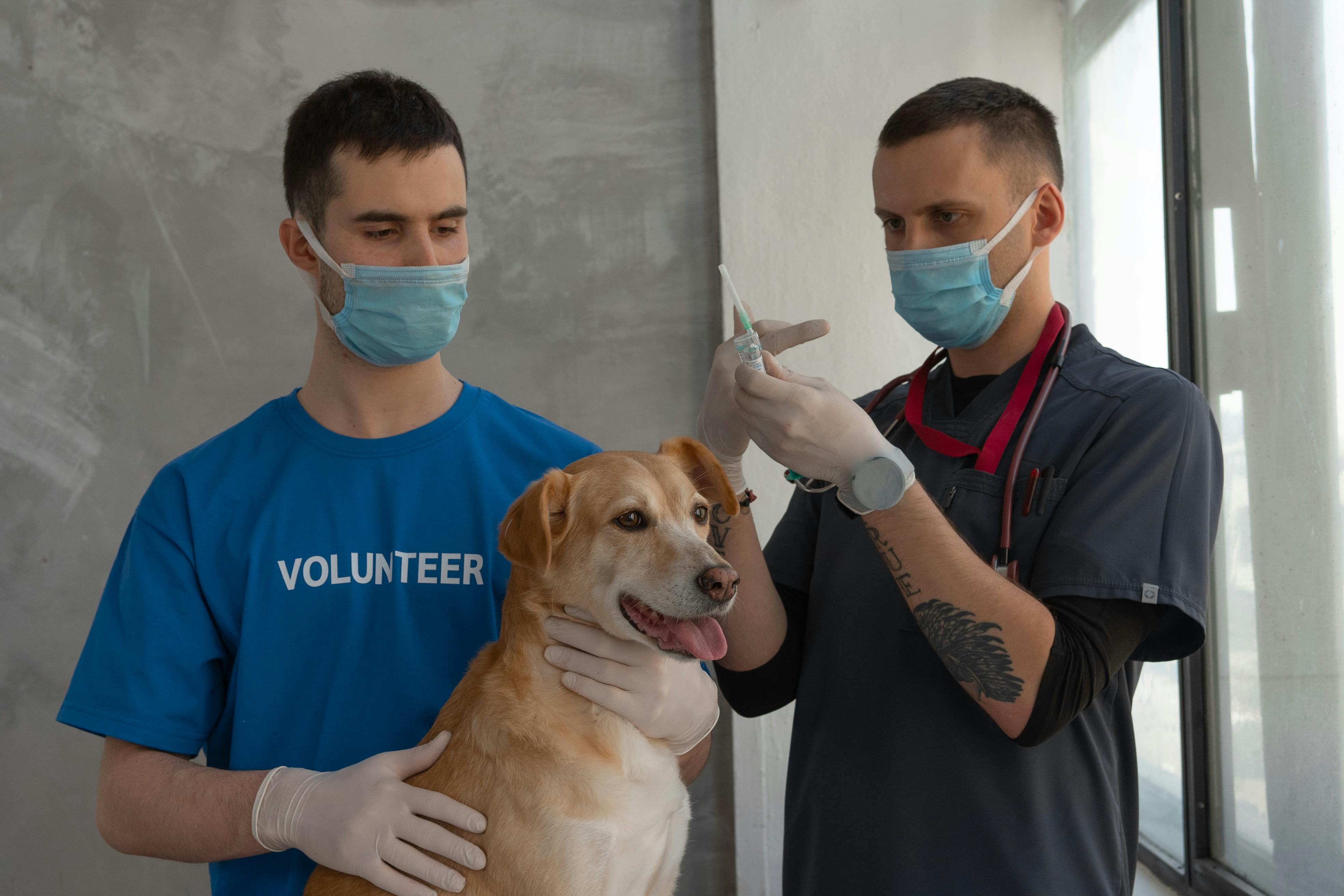 Photo: Mikhail Nilov / Pexels
What vaccines are required by law for dogs (and cats)
Rabies is the only vaccine most state laws actually mandate for dogs, and requirements for cats vary by state. Every other vaccine on the core and non-core lists above is a medical recommendation, not a legal one.
AVMA's compilation of state rabies vaccination laws shows most states require dogs to be currently vaccinated against rabies. The specific interval, minimum age, and any exemption process is set by that state's own statute, not a single national rule. Some states mandate rabies vaccination for dogs but leave cats unregulated, or hand the decision to county or city governments. Because the rule varies by state, check your own state's statute — not a national average — to find your legal minimum.
DHPP, FVRCP, and other core vaccines are not legally mandated anywhere in the US. Vets recommend them because the diseases they prevent are common and serious. Several are untreatable once symptoms appear, which is why vets push the shot even without a legal requirement behind it.
Bordetella and kennel cough: why facilities require it anyway
Bordetella vaccine for dogs near me is a common search precisely because no law requires the shot, yet most boarding kennels, daycares, and groomers demand it before accepting a dog. The requirement comes from the facility's own policy, not a statute.
Bordetella bronchiseptica is a leading cause of kennel cough, a highly contagious upper respiratory infection that spreads quickly in group settings, according to AKC's bordetella vaccine explainer. Protective immunity from an injectable dose takes at least five days after the second shot. An intranasal dose can protect within 48 to 72 hours instead. That timing gap is why boarding facilities ask for proof of vaccination well before drop-off, not on the day of. Immunity from the vaccine lasts only six to twelve months. Facilities that require annual or twice-yearly bordetella proof are matching that actual duration, not padding a rule.
Where to find low-cost dog and cat vaccines near you
Searching "dog shots near me" or "puppy vaccine clinic near me" usually surfaces three distinct options for a cheap shot, each at a different price point below a full-service vet visit.
- Humane society and shelter clinics. Most local humane societies run public vaccine clinics open to any pet, not just adopted animals. The Wisconsin Humane Society and Humane Society Silicon Valley both operate ongoing low-cost clinics as examples of this widespread model. Some require appointments; others run walk-in, first-come, first-served.
- Retail store vaccine clinics. Chains including Tractor Supply host walk-in vaccine clinics through Tractor Supply's PetVet clinic program, staffed by state-licensed veterinarians, with no appointment or office visit fee. Pricing is set per location rather than nationally, so check the store locator for your ZIP code to see the actual cost.
- County or city health department clinics. Many local governments fund periodic low-cost rabies clinics. These are often the cheapest single-shot option available, since the goal is public health compliance rather than practice revenue.
All three routes typically charge close to the vaccine's raw ingredient cost. They skip the office-visit or exam fee a full-service vet adds on top, which is the main reason they run cheaper for the identical shot.
Puppy and kitten vaccine schedule
Both species follow a multi-visit schedule rather than a single appointment, because maternal antibodies block early doses from taking effect.
| Age | Dog vaccines | Cat vaccines |
|---|---|---|
| 6-8 weeks | DHPP (1st dose) | FVRCP (1st dose) |
| 10-12 weeks | DHPP (2nd dose), leptospirosis | FVRCP (2nd dose), FeLV |
| 14-16 weeks | DHPP (3rd dose), rabies | FVRCP (3rd dose), rabies |
| 12 months | Booster series, plus any non-core shots | Booster series, plus any non-core shots |
This schedule matches AAHA's core canine vaccine schedule and Cornell's feline guidance above. A vet may still add or shift doses based on a puppy or kitten's exposure risk and local disease prevalence.
Do adult dogs and cats need vaccines every year?
Not always. Many core vaccines, including rabies, come in both 1-year and 3-year formulations, and a vet may space out revaccination once a pet's immunity is established. The exact schedule still depends on the specific vaccine, the pet's age, and what your state's rabies statute requires.
AAHA's canine revaccination interval guidance recommends DHPP boosters every three years for most adult dogs after the initial series, rather than annually. Rabies revaccination timing follows whichever vaccine label and state law apply, since some states only accept the 1-year formulation regardless of the product's labeled duration. Cats follow a similar pattern under feline guidelines: FVRCP boosters commonly move to a three-year interval in adulthood, while rabies stays tied to state law and the specific vaccine used.
This is why an adult pet's annual vet visit does not always include a full round of core shots. Non-core vaccines like bordetella and canine influenza are the exception — their shorter immunity window means they usually get repeated annually or every six months regardless of a pet's age.
How vaccine costs fit into the first-year budget
Vaccines are one line item in a much larger first-year total, not the whole bill. PetBudget's first-year pet cost ledger puts the full core vaccine series at $330-$440 for a puppy. That sits against an ASPCA-sourced first-year total of $3,221 for a dog and $1,904 for a cat. Vaccines alone account for roughly a tenth of the first year's spending once food, supplies, and spay/neuter are added in.
Pet ownership keeps growing alongside that spending. The total US pet dog and cat population reached 163.6 million animals, a 45% increase since 1996, according to the 2025 AVMA Pet Ownership and Demographics Sourcebook. More pets means more first-year budgets built around exactly these numbers. Run a breed- and location-adjusted estimate, vaccines included, on PetBudget's calculator.
Frequently asked questions
Where can I find cheap dog shots near me?
Local humane societies and animal shelters run walk-in or appointment-based low-cost vaccine clinics open to the public, not just adopted pets. Retail vaccine clinics inside stores like Tractor Supply and Petco, run by companies such as VIP Petcare, are a second option and typically charge per shot with no office visit fee.
What is the average cost of vaccines for dogs?
CareCredit's pricing data puts individual core dog vaccines at $27-$96 each, with DHPP averaging $42, leptospirosis $34, and rabies $35. A puppy's full core series across three to four visits typically lands between $330 and $440 once exam fees are included.
How much is a rabies vaccine for cats?
Rabies vaccination for cats averages $31 nationally, according to CareCredit's cat and kitten vaccination pricing, though low-cost clinics often charge less than half that for the same shot.
Is the bordetella vaccine required by law for dogs?
No. Bordetella is a non-core vaccine with no legal mandate, but most boarding kennels, daycares, and groomers require proof of it before accepting a dog, since it protects against kennel cough. Rabies is the only vaccine most states legally require.
See your own pet's real numbers.
Run the calculator with your breed, metro area, and care choices for a first-year, annual, and lifetime cost estimate — not a national average.