

Key takeaways
- The AKC standard sets a Great Dane minimum of 30 inches at the shoulder for males and 28 inches for females, and adults typically weigh 110 to 175 pounds.
- The Great Dane is the tallest breed, with a record holder named Zeus at 44 inches, but the Mastiff is heavier at 120 to 230 pounds in PetBudget's data.
- Size drives the bill: PetBudget's model feeds a Great Dane 2,808 calories and $1,139 of food a year, 11.5 times a Yorkie, though the dog weighs 26 times more.
The Great Dane is the tallest dog breed, but not the heaviest. The AKC standard sets a male at 30 inches or more at the shoulder. A female must be at least 28 inches. Adults weigh 110 to 175 pounds, and the Mastiff outweighs them at up to 230. This Great Dane size comparison sets the breed beside other giants. It also shows growth by month and prices the size.
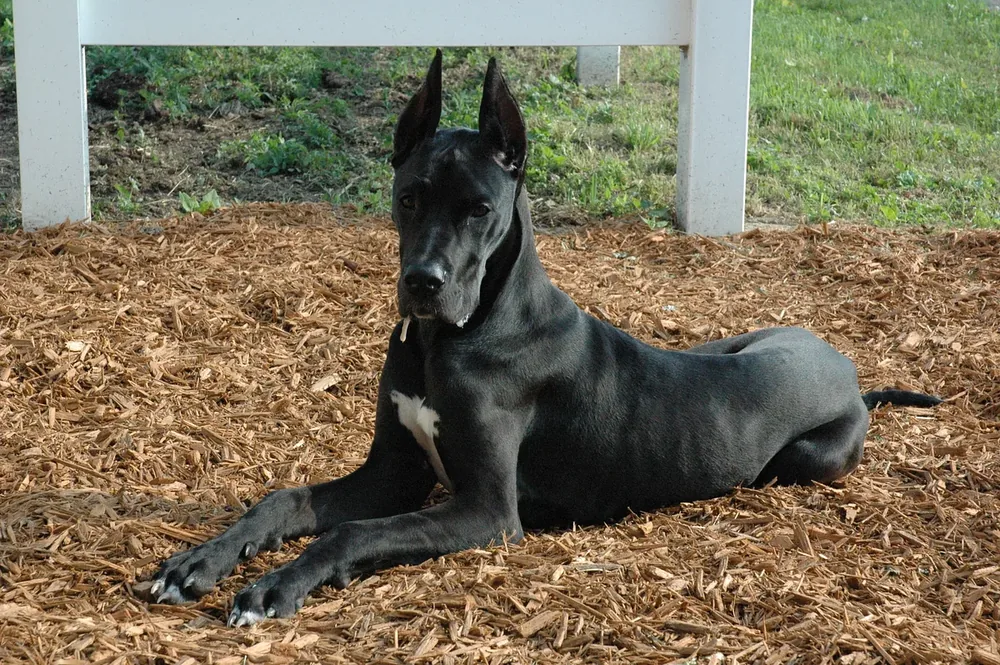 Photo: Melissa / Wikimedia Commons, CC BY 2.0

How big do Great Danes get? Height and weight at a glance
A Great Dane stands 28 to 36 inches tall depending on which standard you read. The AKC Great Dane breed standard sets only minimums. Males "shall not be less than 30 inches at the shoulders," and the female not less than 28 inches. Dogs under those heights are disqualified.
The AKC standard gives no weight. Other sources do, and they overlap only partly.
| Source | Male | Female |
|---|---|---|
| AKC standard height | At least 30 in (32 in or more preferred) | At least 28 in (30 in or more preferred) |
| FCI standard height | 31-35 in | 28-33 in |
| Hepper adult chart | 33-36 in, 135-170 lb | 30-34 in, 110-145 lb |
| PetBudget breed data | 28-32 in, 110-175 lb | same range |
| UK Kennel Club weight, over 18 months | 120 lb | 100 lb |
The FCI heights and the UK Kennel Club weights come from Wikipedia's Great Dane entry. The same entry says the AKC dropped its minimum weight requirement.
44 inches
The shoulder height of Zeus, the Great Dane Guinness World Records listed as the tallest dog on record before he died in September 2014. The dog before him, George, measured 43 inches. See the Great Dane cost breakdown for what a dog this size costs to keep.
Great Dane size compared with other giant breeds
The Great Dane and the Irish Wolfhound are the tallest breeds in PetBudget's data. The Mastiff is the heaviest. The Labrador and Golden Retriever, two of the most common family dogs, look small beside them.
| Breed | Height | Weight |
|---|---|---|
| Irish Wolfhound | 30-35 in | 105-150 lb |
| Mastiff | 27-33 in | 120-230 lb |
| Great Dane | 28-32 in | 110-175 lb |
| St. Bernard | 26-30 in | 120-180 lb |
| Newfoundland | 26-28 in | 100-150 lb |
| Labrador Retriever | 21.5-24.5 in | 55-80 lb |
| Golden Retriever | 21-24 in | 55-75 lb |
Height and weight tell different stories. The Mastiff is no taller than the Dane here, yet it outweighs it. Height is a poor guide to bulk. Our Irish Wolfhound price guide and Mastiff price guide cover the cost of those two.
Great Dane growth chart by month
A Great Dane puppy gains roughly 15 pounds a month between 2 and 6 months. Hepper's Great Dane growth chart was updated January 30, 2025. It lists males at 20 to 30 pounds at 2 months and 80 to 100 pounds at 6 months.
| Age | Male weight | Female weight | Height |
|---|---|---|---|
| 2 months | 20-30 lb | 15-25 lb | 13-18 in |
| 3 months | 35-45 lb | 25-35 lb | 17-23 in |
| 4 months | 55-65 lb | 45-55 lb | 21-26 in |
| 5 months | 70-85 lb | 60-75 lb | 23-30 in |
| 6 months | 80-100 lb | 65-80 lb | 26-33 in |
| 8 months | 100-120 lb | 80-100 lb | 27-35 in |
| 9 months | 110-130 lb | 85-105 lb | 28-35 in |
| 1 year | 125-175 lb | 100-130 lb | 29-36 in |
The Elanco puppy growth chart describes the giant class more cautiously. It lists 52 to 69 pounds at 6 months and 156 to 204 pounds at 18 months. It also says giant puppies typically gain 2 to 3 pounds a week, and the biggest up to 5. Even the bottom of Hepper's 6-month range sits above Elanco's generic giant band.
Use a chart as a guide, not a target. Our puppy weight calculator guide explains how to track your own puppy's curve.
Male and female Great Dane size
A male Great Dane runs about 25 pounds heavier than a female. He is also 2 to 3 inches taller. Hepper's adult chart puts males at 135 to 170 pounds and females at 110 to 145. The AKC minimum heights differ by 2 inches. The gap shows early. A 6-month male weighs 15 to 20 pounds more than a female.
The sex gap carries a price. Feeding a 152-pound male and a 127-pound female with PetBudget's formula gives about 2,955 and 2,584 calories a day. That is $1,195 and $1,045 a year in food, a $150 difference. Neither number includes the puppy year, when a growing dog eats more per pound.
How big is a Great Dane puppy at 8 weeks?
A Great Dane puppy at 8 weeks weighs 15 to 30 pounds. Hepper lists males at 20 to 30 pounds and females at 15 to 25. Elanco's giant class is narrower at 16 to 21 pounds for the first two months.
At that age the puppy stands 13 to 18 inches tall. It will roughly double that height by its first birthday. Ask the breeder for both parents' weights, since they are the best clue to adult size.
When do Great Danes stop growing?
Great Danes reach full height at around age two, and the body keeps filling out after that. Hepper says growth comes in spurts until about 8 months. Appetite may then drop and growth seems to stall, but the dog keeps growing more slowly. Hips, chest and muscle develop into the second year.
Elanco agrees. Giant breeds stop growing at about 2 years, large breeds at 14 to 18 months and medium breeds at about 1 year. A lanky look at 12 months is common.
Keep a growing Great Dane lean
A lean puppy grows more safely than a heavy one. Susan Wynn's IVC Journal article on feeding large breed puppies links overweight puppies to developmental orthopedic disease. Feeding for maximum growth raises the same risk. She recommends a body condition score of 4 out of 9 and a weekly check.
She also says never to free feed, and to ignore the amounts printed on the bag. The article warns that giant breed puppies on fresh food diets need the same score check. A fast-growing Dane that tops the chart at every visit is not winning. Slow the food, not the growth chart.
Does a Great Dane's size raise health risk?
Yes, size is a health variable. A 2026 Dog Aging Project study in the Journal of the American Veterinary Medical Association drew on 47,444 enrolled dogs. It found higher odds of bloat in dogs with a body weight over 40 kilograms, or about 88 pounds. A Great Dane at the PetBudget midpoint of 142.5 pounds weighs about 65 kilograms.
Rapid growth is the other concern. Wikipedia reports that fast growth in giant dogs can contribute to wobbler disease. Pressure on the spinal cord weakens the legs. The same entry describes bloat as the breed's greatest killer. Our Great Dane lifespan guide covers the bloat numbers and a preventive surgery. Our Great Dane feeding chart covers how to keep growth steady.
What a Great Dane's size costs
A Great Dane costs about twice as much per year as a Yorkie. PetBudget's model puts the Dane at $3,674 a year and the Yorkie at $1,885. Size sets the food, insurance and supply lines.
| Cost | Yorkie (5.5 lb) | Great Dane (142.5 lb) |
|---|---|---|
| Food a year | $99 | $1,139 |
| Calories a day | 245 | 2,808 |
| Insurance a year | $599 | $1,240 |
| Starter supplies | $404 | $618 |
| First-year total | $4,191 | $6,522 |
| Lifetime (model life) | $26,811 (13 yr) | $32,240 (8 yr) |
The Dane weighs 26 times as much as the Yorkie but eats only 11.5 times the calories. Energy needs scale with body weight to the 0.75 power. The Dane eats about 20 calories per pound against 45 for the Yorkie. Wikipedia makes the same point: giant dogs have a slower metabolism and need less energy per pound.
The short life offsets the high yearly cost. At an 8-year life the Dane runs $4,030 per year of life, against $2,062 for the 13-year Yorkie. Price the whole picture in the PetBudget calculator, and compare any two breeds on the compare page.
How to measure your Great Dane
Measure shoulder height the way the AKC standard does, at the shoulders. Follow these steps:
- Stand the dog square on a flat floor with its head up.
- Place a ruler or a level flat across the shoulder blades.
- Measure from the floor to the underside of the level.
- Weigh on a vet scale every month through the first two years.
- Compare against the chart ranges, and ask your vet about anything far outside them.
Frequently asked questions
How big do Great Danes get?
Adult males stand at least 30 inches at the shoulder and females at least 28 inches under the AKC standard. Most adults weigh 110 to 175 pounds. Hepper lists adult males at 33 to 36 inches and 135 to 170 pounds.
How much does a Great Dane weigh at 6 months?
Hepper's chart shows males at 80 to 100 pounds and females at 65 to 80 pounds at 6 months. That is more than half of the adult weight. Growth continues for about two more years.
When do Great Danes stop growing?
Hepper says growth comes in spurts until about 8 months, with full height near age two. Elanco puts giant breeds at about 2 years. Expect the chest and muscle to keep filling out after height stops.
Is the Great Dane the biggest dog breed?
It is the tallest, not the heaviest. Zeus, a Great Dane, held the Guinness record at 44 inches. The Mastiff is heavier, with a PetBudget range of 120 to 230 pounds against 110 to 175 for the Dane.
Does a Great Dane's size raise its health risks?
Yes. A 2026 Dog Aging Project study found dogs over 40 kilograms had higher odds of bloat. A Great Dane averages about 65 kilograms. Wobbler disease is also linked to rapid growth in giant breeds.
See your own pet's real numbers.
Run the calculator with your breed, metro area, and care choices for a first-year, annual, and lifetime cost estimate — not a national average.
Comments
Comments are moderated before they appear. Constructive questions, corrections and first-hand pet cost experiences are welcome.
Verified Dialogue
Sort by: Chronological (earliest)Loading comments…