

Key takeaways
- An Irish wolfhound and great dane mix weighs about 105-175 pounds, lives about 7-8 years, and costs roughly $30,253 over a life, or about $4,000 for each year, in PetBudget's model.
- Crossing two giant breeds does not cancel their shared risks: both parents carry bloat, heart disease and bone cancer, and a Great Dane has a 42.4% lifetime bloat risk.
- A UC Davis study of 27,254 affected dogs found mixed breeds had fewer inherited disorders than purebreds in 10 of 24 cases, so a cross helps with some problems but not all.
An Irish wolfhound and great dane mix is a 105-175 pound dog that lives about 7-8 years. In PetBudget's model such a dog costs about $6,502 in year one and $3,654 a year after, or $30,253 over 7.5 years. That is roughly $4,000 for every year of life. Most owners lose money on the same three items: a bloat emergency, a heart exam and a bone cancer diagnosis. This guide shows what each costs and how to lower the odds.
Irish wolfhound and great dane mix at a glance
An Irish wolfhound and great dane mix is a giant dog with a short life and a high yearly bill. The cross is not a recognized breed with its own standard, so every number below is built from the two parents. We average the parents and show the result next to each.
| Measure | Great Dane | Irish Wolfhound | Cross (midpoint) |
|---|---|---|---|
| Adult weight | 110-175 lb | 105-150 lb | 105-175 lb |
| Height | 28-32 in | 30-35 in | 28-35 in |
| Modeled lifespan | 8 years | 7 years | 7.5 years |
| First-year total | $6,522 | $6,482 | $6,502 |
| Each year after year one | $3,674 | $3,634 | $3,654 |
| Lifetime total | $32,240 | $28,286 | $30,253 |
| Cost per year of life | $4,030 | $4,041 | $4,034 |
| Emergency fund target | $5,000 | $5,000 | $5,000 |
About $4,000
Cost per year of life for a Great Dane, an Irish Wolfhound or a cross of the two. Start your own estimate in the pet cost calculator.
The cost per year of life is almost identical for both parents. The wolfhound's lower food bill is offset by its higher grooming bill, and its shorter life concentrates the same spending into fewer years. A cross lands between them.
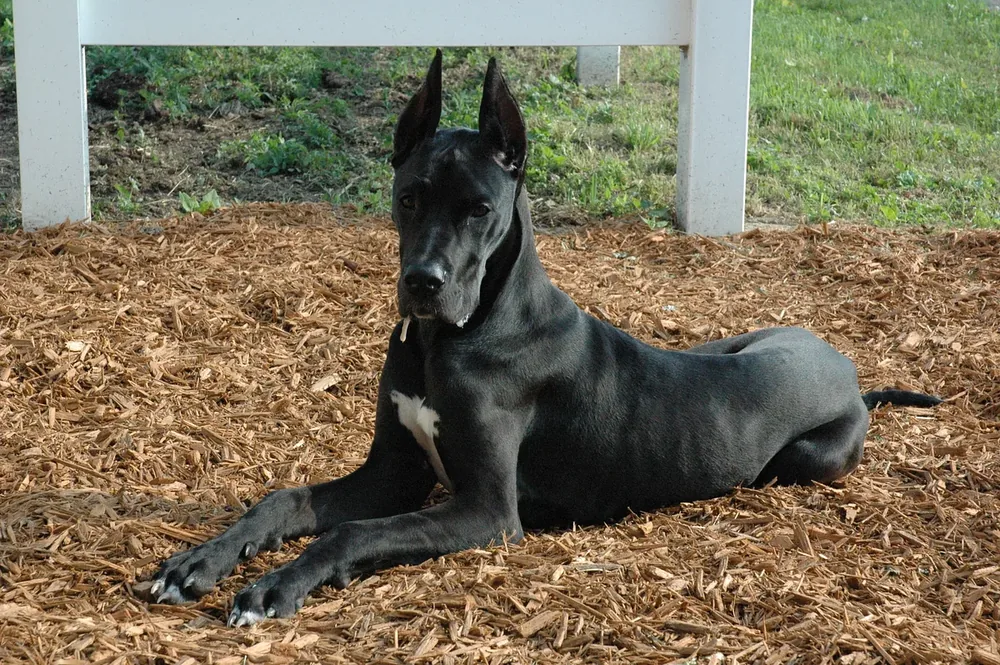 Photo: Melissa / Wikimedia Commons, CC BY 2.0

How big does an Irish wolfhound and great dane mix get?
A cross grows to between 105 and 175 pounds and 28 to 35 inches at the shoulder. That span is not a prediction. It is the range that covers both parents, taken from PetBudget's breed data. A puppy that favors the Great Dane's frame will land at the high end for weight, and one that favors the wolfhound will be taller and leaner.
Size drives the budget more than any other fact. A Great Dane eats about $1,139 of food a year in the model, against $519 for an average mixed-breed dog. Starter supplies run $618 for the giant tier against $475. Beds, crates and car space also get larger. Our Great Dane weight and size guide has a month-by-month puppy growth table that fits the larger parent. For a method that works on any mixed-breed puppy, read our mixed-breed puppy growth chart guide.
Does a giant breed mix live longer than the parents?
Probably not by much. A cross of two 7-8 year breeds is most likely to land near 7-8 years, and no study has measured the cross itself. The numbers that bracket it are below.
The Irish Wolfhound figures come from two breed surveys. A Swedish owner survey in Acta Veterinaria Scandinavica found a median of 7.5 years. A U.S. club survey found a mean of 6.47 years. The Banfield life-table study in Frontiers in Veterinary Science used U.S. clinic records and put giant dogs at 9.51 years life expectancy at birth. Giant dogs as a group live longer than either breed's survey figure, which hints that a lucky cross could beat the parents. Do not budget for that.
For breed-specific detail, see the Great Dane lifespan guide and the Irish wolfhound lifespan guide.
What does hybrid vigor really change?
Hybrid vigor lowers the odds of some inherited disorders and leaves others untouched. Bellumori and colleagues compared 24 inherited disorders in 27,254 affected dogs at UC Davis between 1995 and 2010. Thirteen showed no difference between purebred and mixed-breed dogs. Ten were more common in purebreds, including dilated cardiomyopathy, elbow dysplasia, cataracts and hypothyroidism. One, cranial cruciate ligament rupture, was more common in mixed breeds.
Two cautions apply. The records come from a single California teaching hospital, so referral bias is possible. And the study compared mixed breeds with purebreds in general, not a cross of two breeds that share a disease. When both parents carry the same risk, the puppy inherits no protection against it. A cross helps most when the parents have different weak spots.
Which health risks do both parents share?
Both parents carry bloat, dilated cardiomyopathy and bone cancer, so a cross inherits all three. The table lists each condition from PetBudget's breed data and who carries it.
| Condition | Great Dane | Irish Wolfhound | Typical cost |
|---|---|---|---|
| Bloat (GDV) | Yes | Yes | $2,000-$7,500 |
| Dilated cardiomyopathy | Yes | Yes | $1,900-$3,200 (Great Dane claims) |
| Bone cancer (osteosarcoma) | Yes | Yes | $2,200-$4,900 (Great Dane claims) |
| Hip dysplasia | Yes | Not listed | $7,000-$9,000 per hip |
| Portosystemic shunt | Not listed | Yes | No model figure |
Bloat is the one to plan for first. A Purdue epidemiology study, summarized by Tufts' Dr. Jerold Bell on VIN, found a 42.4% lifetime bloat risk for the Great Dane, the highest of any breed listed. PetBudget's data lists bloat for the Irish Wolfhound too. Trupanion's commonly claimed conditions sheet puts an average Great Dane bloat claim at $2,500-$3,900, using 2019 claims. MetLife publishes a wider range of $2,000 to over $7,500.
The prevention is a gastropexy. Embrace Pet Insurance lists $800-$3,000 standalone and $300-$400 or more extra when done during a spay or neuter. Our Great Dane lifespan guide explains the Purdue findings on repeat bloat. Ask your vet to schedule it with the spay.
What does an Irish wolfhound and great dane mix cost per year?
The yearly cost is about $3,654 after year one, and food and insurance are the two largest lines. Averaging the parents' lines gives the table below.
| Line | Great Dane | Irish Wolfhound | Cross (midpoint) |
|---|---|---|---|
| Food | $1,139 | $982 | $1,061 |
| Vet care | $918 | $918 | $918 |
| Grooming | $195 | $312 | $254 |
| Insurance | $1,240 | $1,240 | $1,240 |
| Supplies and toys | $182 | $182 | $182 |
| Total | $3,674 | $3,634 | $3,654 |
Insurance is the largest single line at $1,240 a year, which is the top premium tier in the model. The premium is high because both parents sit in the highest risk tier. A rough-coated cross may need the wolfhound's grooming, while a short-coated cross needs the Dane's. Treat grooming as $195-$312.
How much should you pay for an Irish wolfhound and great dane mix?
No survey gives a reliable price for this cross. PetBudget's giant-tier default for a purchased puppy is $1,400, and it is a placeholder. Purebred prices are better documented. Our Irish wolfhound price guide cites $1,200-$2,500 from Spot Pet Insurance and up to $3,000 from Hepper for show lineage, and rescue fees of $300-$600.
Be skeptical of any breeder who charges more for a mix than for either parent. A planned cross between two breeds with heart and bloat risks should come with health papers for both parents. Rescue is the best value. Ask any rescue what the fee includes, because many include vaccines and surgery.
How does the cross compare with other giant breeds?
The cross costs about $4,034 per year of life. Its two parents rank first and second among the 24 giant breeds in PetBudget's data, because each combines a top insurance line with a short modeled life.
| Breed | Modeled life | Lifetime total | Cost per year of life |
|---|---|---|---|
| Great Pyrenees | 10 years | $34,868 | $3,487 |
| Bernese Mountain Dog | 8 years | $30,656 | $3,832 |
| Mastiff | 8 years | $30,944 | $3,868 |
| Great Dane | 8 years | $32,240 | $4,030 |
| Irish Wolfhound | 7 years | $28,286 | $4,041 |
The lesson is that a lifetime total can hide the real price. The Irish Wolfhound has the lowest lifetime bill of these five because its life is shortest. A longer-lived giant such as the Great Pyrenees costs more in total but less for every year you have the dog. If you want a giant dog that costs less per year, compare these breeds side by side in the breed comparison tool.
What does a bad year look like?
A bad year for this cross adds $2,000 to $8,000 to the ordinary $3,654, depending on the emergency. The table shows the main cases, using the cost sources above.
| Event | Added cost | Year total |
|---|---|---|
| Ordinary year | $0 | $3,654 |
| Bloat emergency (Trupanion Great Dane average) | $2,500-$3,900 | $6,154-$7,554 |
| Bloat emergency (MetLife published range) | $2,000-$7,500 | $5,654-$11,154 |
| Heart disease diagnosis (Great Dane claims) | $1,900-$3,200 | $5,554-$6,854 |
| Bone cancer (Great Dane claims) | $2,200-$4,900 | $5,854-$8,554 |
| One hip replacement | $7,000-$9,000 | $10,654-$12,654 |
A $5,000 reserve covers most rows on its own. Only the severe bloat case and the hip replacement exceed it. That is why the model sets the giant-tier reserve at $5,000. If you would rather transfer the risk, our insurance versus emergency fund guide shows the break-even math. At $1,240 a year, five years of premiums equal the reserve.
What is daily life with a giant cross like?
Daily life with this cross is quiet and large. PetBudget lists 45 minutes of exercise a day for both parents. The Great Dane's energy rating is 3 out of 5 and the Irish Wolfhound's is 2. Shedding is 3 for the Dane and 2 for the wolfhound.
The size is what changes your routine. A 150-pound dog needs a big crate, a raised feeder, a vehicle it can fit in and a vet who can handle it on a scale. Starter supplies run $618 against $475 for an average mixed breed. A giant dog also needs more medication by weight, so drug and anesthesia bills rise with size. Ask your vet to quote surgery by weight before you decide.
How can you lower the risks before you buy?
You can lower the risks by screening the parents, planning surgery early and funding the reserve first. Follow the steps in order.
- Ask for both parents' heart results. Request echocardiogram records for each parent. Dilated cardiomyopathy is hereditary in both breeds.
- Ask for hip scores. The Orthopedic Foundation for Animals runs a hip dysplasia program that rates hips on X-rays.
- Book the gastropexy with the spay or neuter. It costs less combined, and it removes the twist that kills in hours.
- Split meals. Ask your vet about two or three smaller meals and a rest after eating. No feeding rule removes the bloat risk.
- Fund $5,000 first. That is the model's reserve for a giant dog. A bloat emergency can use all of it.
- Insure while the puppy is young. Heart and joint problems turn into pre-existing conditions once they appear in the record.
Giant puppies also grow fast. Do not over-feed or over-exercise a young dog. Growth plates stay open for months, and rapid growth raises joint stress. Weigh the puppy every two to four weeks and bring the numbers to the vet.
Is an Irish wolfhound and great dane mix right for your budget?
An Irish wolfhound and great dane mix suits a household that can fund $3,654 a year, hold $5,000 in reserve and accept a short life. It does not suit a tight budget. The wolfhound costs $3,954 less over a life than the Dane, but only because the model gives it one year less.
If the numbers feel heavy, compare other giant breeds. The breed comparison tool shows lifetime cost side by side, and the calculator adjusts for your metro. If the budget is firm, a mid-size mixed-breed dog costs $31,674 over 13 years in the model, or $2,436 per year of life.
Frequently asked questions
How big does an Irish wolfhound and great dane mix get?
Expect 105-175 pounds and 28-35 inches at the shoulder, which is the span covered by the two parents. The result depends on which parent the puppy favors and on sex. Males usually run larger.
How long does a great dane irish wolfhound mix live?
Plan for 7-8 years. PetBudget models 8 years for a Great Dane and 7 for an Irish Wolfhound, and no breed study exists for the cross. Banfield data put giant dogs at 9.51 years life expectancy at birth.
How much does an Irish wolfhound and great dane mix cost per year?
About $3,654 a year after year one, which is the midpoint of the Great Dane's $3,674 and the Irish Wolfhound's $3,634 in PetBudget's model. The first year runs about $6,502.
Is a giant breed mix healthier than a purebred?
Only partly. A UC Davis study found 10 of 24 inherited disorders were more common in purebreds, 13 showed no difference and 1 was more common in mixed breeds. Two giant parents that share a disease give the puppy little protection against it.
Should I get a gastropexy for a giant breed mix?
Ask your vet. A gastropexy tacks the stomach to the body wall so it cannot twist. It is cheapest when done during spay or neuter, and both parent breeds are deep-chested.
See your own pet's real numbers.
Run the calculator with your breed, metro area, and care choices for a first-year, annual, and lifetime cost estimate — not a national average.
Comments
Comments are moderated before they appear. Constructive questions, corrections and first-hand pet cost experiences are welcome.
Verified Dialogue
Sort by: Chronological (earliest)Loading comments…