

Key takeaways
- The key Great Pyrenees breed traits are guardian instinct, loud barking at night, a drive to patrol and roam, a heavy double coat and an independent mind, and each one has a cost.
- A 2020 livestock guardian dog presentation hosted by WSU Extension says any guardian dog can jump a 4-5 foot fence and recommends 4-6 foot fencing, which is why a secure yard matters more for this breed than for most.
- PetBudget's model puts a Great Pyrenees at $6,050 in year one and $3,202 a year after, and only one of 24 giant breeds costs less to feed.
The Great Pyrenees is a calm 85-115 pound guardian dog that barks at night, patrols its territory and sheds heavily. The AKC says it was bred to deter sheep-stealing wolves and other predators on snowy mountaintops, and that today's dogs are mellow companions and vigilant guardians of home and family. Those great pyrenees breed traits are a gift in the right home. In the wrong one, each trait turns into a fence bill, a neighbor complaint or a vacuum bag. Living with a Great Pyrenees is like sharing your home with a night watchman who never clocks out.
Great Pyrenees breed traits at a glance
Each Great Pyrenees trait has a practical cost, and the table below pairs them. The sources are PetBudget's breed data, the AKC, GreatPetCare and a livestock guardian dog presentation hosted by WSU Extension.
| Trait | What it means at home | What it costs you |
|---|---|---|
| Guardian instinct | Alert to anything unusual, wary of strangers | Training and socialization from the first week |
| Barking | Vocal, including at night | Neighbor tolerance, a quiet-hours plan |
| Roaming drive | Patrols a territory and tests fences | A 4-6 foot fence, about $1,860-$4,834 installed for a typical yard |
| Double coat | Heavy shedding, spring blowout | About 30 minutes of brushing a week, $312 a year grooming |
| Independence | Smart, needs to see the point | Patience and short sessions |
| Size | 85-115 pounds, 25-32 inches | Food $819, insurance $1,061 a year |
| Moderate energy | 45 minutes a day in the model | Walks that act as perimeter patrol |
$6,050
First-year cost of a Great Pyrenees in PetBudget's model, then $3,202 a year. Read the full Great Pyrenees cost breakdown or build your own in the pet cost calculator.
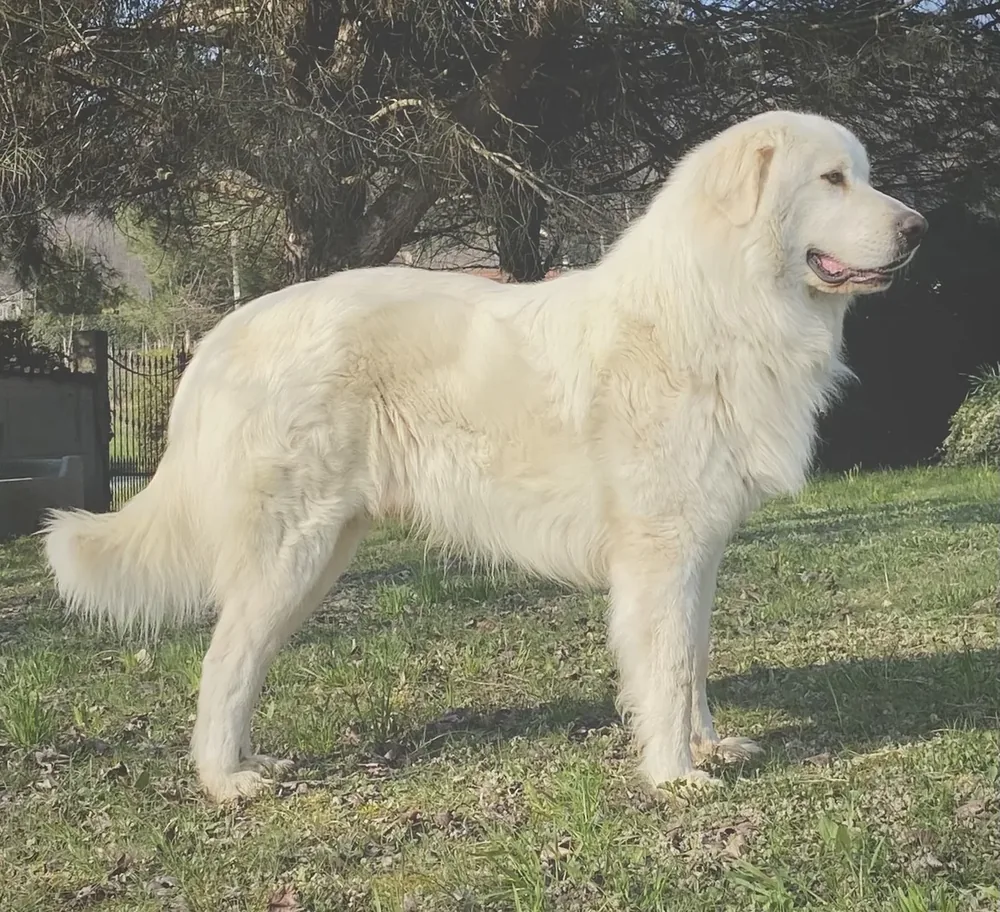 Photo: Phoenix887788 / Wikimedia Commons, CC BY-SA 4.0

Great Pyrenees temperament: calm at home, wary of strangers
The Great Pyrenees temperament is gentle and patient with family and reserved with strangers. GreatPetCare's breed profile describes the dog as confident, gentle and affectionate with family, patient with children, and suspicious of strangers. It adds that the breed is territorial and protective by nature, so early socialization is essential.
The AKC breed page states the same history in its first line. This is a working guardian first and a pet second.
A guardian is not a friendly greeter. The WSU Extension-hosted presentation makes a point owners often miss: a friendly guardian dog will not necessarily allow even a nice visitor onto her property. Plan introductions to delivery drivers, repair workers and your own guests. A leash and a calm introduction at the gate work better than hoping the dog sorts it out.
The presentation also says a good guardian dog never becomes inherently dangerous when handled and socialized. It also warns that an aggressively barking guardian is not frightened and cannot be calmed. The takeaway is to teach the dog what counts as normal before it decides for itself.
Why do Great Pyrenees bark so much?
Great Pyrenees bark because barking is the first step of their job. The presentation says guardian dogs are vocal and bark when anything appears suspicious or out of the ordinary, and that their barking accelerates as a threat grows larger. It also lists bluntly that these dogs bark at night.
Great Pyrenees barking is therefore not a training failure. Three points to plan around:
- Nighttime barking signals activity. The speaker notes that night barking is an indication of creatures your neighbors probably do not want around.
- Pointless barking can be trained down. The presentation says annoying barking can be effectively disciplined and essentially eliminated, while real guarding stays.
- Territory shapes volume. A dog with a small fenced yard next to a busy street sees more triggers than a dog on acreage.
Check your local rules before you buy. The presentation explains that barking ordinances may not apply to guardian dogs on agricultural land with a right-to-farm protection. That protection needs ag zoning and real livestock. A suburban Great Pyrenees has no such shield, and the neighbors still hear the dog.
Do Great Pyrenees roam, and how high should the fence be?
Great Pyrenees roam in the sense that they patrol, and the fix is a tall, tight fence. The WSU Extension-hosted presentation says guardian dog fences must go to the ground, stand 4-6 feet tall, have no step-ladders and no gaps. It adds that any guardian dog can easily jump a 4-5 foot fence, because big and low energy does not mean not athletic.
GreatPetCare agrees from the pet side. It says the breed needs a securely fenced yard that prevents roaming and should not be walked off-leash. The presentation says the same: never allow them outside the fence without a leash.
Our dog fence cost guide puts a physical fence at $1,860-$4,834 installed, averaging $3,270. A 4-6 foot fence costs more than a basic one. An invisible fence is cheaper, at $800-$2,800, but it does not keep other animals out. For a Great Pyrenees, treat a physical fence as part of the purchase price.
For a full price breakdown including the puppy, see the Great Pyrenees price guide.
How much does a Great Pyrenees shed?
A Great Pyrenees sheds heavily year-round and blows its coat in spring. PetBudget rates shedding 5 out of 5 in its breed data. Only 14 of 236 dogs share that top score, and they include the Newfoundland, Leonberger, Akita and Siberian Husky.
GreatPetCare calls the breed an average to high shedder with most hair loss in spring. It suggests about 30 minutes of brushing each week to remove dead hair. In the model, grooming costs $312 a year, which is $44 above the average dog's $268 among giant breeds.
A few habits cut the work:
- Brush weekly with an undercoat rake, and brush daily during the spring blowout.
- Ask before you shave. A double coat insulates, so talk to your vet or groomer before clipping a Pyr.
- Buy a strong vacuum. White hair shows on dark furniture and clothing.
How much do Great Pyrenees eat?
A Great Pyrenees eats less than most giants. PetBudget's model puts food at $819 a year, which is lower than every giant breed but one. The giant-tier average is $974.
The presentation explains why with a rule of thumb. It says guardian dogs have a lower metabolism that requires less food for their size. It shows one dog at 110 pounds eating 4 cups a day. Treat that as one example, not a feeding chart. Our dog feeding guide shows how to calculate calories by weight, and a Great Pyrenees on the low end of the range saves real money against a Great Dane at $1,139 a year.
How hard is it to train a Great Pyrenees?
A Great Pyrenees is hard to train for obedience and easy to train for house manners. GreatPetCare calls the breed intelligent but independent, and says it bores easily, so keep sessions short and varied. The WSU Extension-hosted presentation says guardian dogs are difficult to train because they are very smart. They can excel at basic obedience, but they need to see the point.
The same presentation has a useful note on recall. It says "Come" can be taught but requires trust and persuasion, and that house-breaking is easy but becomes unreliable if the dog is kept inside too much of the time. Plan for off-leash restraint, not off-leash recall.
Expect a long road. The presentation prices trained working guardians at $500-$2,000 and says they are 14 months to 2-3 years old. That age hints at how long maturity takes. Puppy classes cost $260 in the model, so budget for a second round.
How much exercise does a Great Pyrenees need?
A Great Pyrenees needs moderate daily exercise. PetBudget's breed data lists 45 minutes a day and an energy rating of 2 out of 5. GreatPetCare says short or moderate leashed walks a couple of times a day usually meet the need.
The WSU Extension-hosted presentation adds a warning. A guardian dog's body is not designed to be a jogging companion, because its joints and lungs suit short bursts of activity, not sustained repetitive running. In the dog's mind, a leash walk is a perimeter patrol. Hikes work if you accept that the dog is along for protection and not for exercise.
What health costs go with a Great Pyrenees?
The Great Pyrenees lives 10-12 years, and its biggest health costs are bloat, hip dysplasia and kneecap problems. PetBudget's model uses 10 years for its lifetime total of $34,868 and lists these conditions with costs.
| Condition | Typical cost | Source |
|---|---|---|
| Bloat (GDV) emergency | $2,000 to over $7,500 | MetLife bloat guide |
| Hip dysplasia, hip replacement per hip | $7,000-$9,000 | Iowa State University |
| Patellar luxation surgery | $1,000-$5,000 | MetLife luxating patella guide |
Bloat is the one to prepare for. Our Great Dane lifespan guide explains the gastropexy that prevents the stomach from twisting. Ask the same question for a Pyr at spay or neuter time. Fund a $5,000 emergency reserve, which is the model's target for giant breeds, or compare the options in our pet insurance versus emergency fund guide.
How does the Great Pyrenees compare with other guardian breeds?
The Great Pyrenees costs about the same per year as other guardian breeds, and it sheds the most. PetBudget's data puts five livestock guardian breeds within $204 a year of each other.
| Breed | Weight | Modeled life | Shedding | Energy | Lifetime cost |
|---|---|---|---|---|---|
| Great Pyrenees | 85-115 lb | 10 years | 5 of 5 | 2 of 5 | $34,868 |
| Kuvasz | 70-115 lb | 11 years | 4 of 5 | 3 of 5 | $38,125 |
| Anatolian Shepherd | 80-150 lb | 12 years | 4 of 5 | 3 of 5 | $41,680 |
| Caucasian Shepherd | 99-170 lb | 11 years | 4 of 5 | 2 of 5 | $40,314 |
| Central Asian Shepherd | 88-170 lb | 13 years | 3 of 5 | 2 of 5 | $45,189 |
The Great Pyrenees has the lowest lifetime total of the five, but only because the model gives it the shortest life. The Central Asian Shepherd costs more in total and about the same per year. Our Anatolian shepherd price guide and Central Asian shepherd price guide cover those two in detail.
What should you ask a breeder or rescue before you commit?
Ask about both parents, the temperament they show at home and the age the puppy leaves. The WSU Extension-hosted presentation gives selection advice for working guardian dogs. Pet buyers can borrow the same questions.
- Meet both parents. The presentation says to insist on seeing both parents living and working with stock.
- Ask whether they work. It says that if the breeder does not trust a parent with livestock, you should not trust its offspring.
- Refuse an early sale. A breeder who wants to sell a puppy younger than 10 weeks is a huge red flag, per the presentation.
- Ask for health checks. The presentation asks for hip, elbow and eye certification, unless the parents are at least 5-6 years old and working soundly.
- Be wary of crossbreeds. The presentation warns against crosses outside the guardian breeds.
- Consider an adult rescue. The presentation prices adopting an adult guardian at about $500 and warns that the dog is likely to have some issues.
The presentation prices puppies at $250-$1,500 and trained adults at $500-$2,000. Pet-market prices are higher. Our Great Pyrenees price guide shows breeder ranges of $800-$2,500 from named U.S. sources.
How do Great Pyrenees breed traits add up in dollars?
The Great Pyrenees traits add up to $6,050 in year one, and $3,030 of that is one-time setup. Setup is the puppy, the first vet visit, supplies and training. The recurring lines are insurance, vet care, food and grooming.
Add the fence on top. Setup in the model does not include fencing, so a family without one should add $1,860-$4,834 or more for a physical fence. Run the numbers for your metro in the calculator before you commit.
Is a Great Pyrenees right for your home?
A Great Pyrenees suits a home with a large fenced yard, tolerant neighbors and an owner who accepts a stubborn, vocal dog. It does not suit an apartment, an unfenced yard or a household that wants an off-leash running partner. Use the table to check your fit.
| Your situation | Fit | Why |
|---|---|---|
| Rural home with 4-6 foot fence | Good | Space, privacy and a job for the dog |
| Suburban yard, close neighbors | Risky | Night barking and a patrol drive |
| Apartment or condo | Poor | Barking, size and shedding collide |
| Active runner wanting a jogging partner | Poor | Body built for bursts, not distance |
| Family with calm older children | Good | Patient with children, per GreatPetCare |
| First-time owner with a small budget | Risky | $5,000 reserve and a fence |
If the fit is wrong, compare other giant breeds in the breed comparison tool. If it is right, start by pricing the fence and the first year, and remember the fence comes first.
Frequently asked questions
What are the main Great Pyrenees breed traits?
The main traits are a calm, gentle nature at home, a strong guardian instinct, frequent barking, independence and a thick double coat. The AKC describes the breed as bred to deter sheep-stealing wolves and other predators on snowy mountaintops, and as mellow companions today.
Do Great Pyrenees bark a lot?
Yes. A WSU Extension-hosted guardian dog presentation says these dogs are vocal and bark when anything appears suspicious, and that they bark at night. Training can reduce pointless barking, but not the guarding instinct.
Can a Great Pyrenees live in an apartment?
It is possible but difficult. The breed needs a securely fenced yard to prevent roaming, barks at perceived threats and sheds heavily. A home with a big fenced yard and tolerant neighbors is a safer fit.
How much do Great Pyrenees shed?
They shed heavily. PetBudget rates shedding 5 out of 5, a score shared by only 14 of 236 dogs in its data, and GreatPetCare suggests about 30 minutes of brushing a week with the heaviest loss in spring.
Are Great Pyrenees hard to train?
They are intelligent and independent, so they respond to patience, short sessions and a clear point. The WSU Extension-hosted presentation says guardian dogs are hard to train because they are smart and need to see the point.
See your own pet's real numbers.
Run the calculator with your breed, metro area, and care choices for a first-year, annual, and lifetime cost estimate — not a national average.
Comments
Comments are moderated before they appear. Constructive questions, corrections and first-hand pet cost experiences are welcome.
Verified Dialogue
Sort by: Chronological (earliest)Loading comments…