

Key takeaways
- The Pudelpointer is a German hunting breed started in 1881 by crossing a Poodle with English Pointers, and it has a harsh, wiry coat that sheds low to moderately in PetBudget's breed ratings.
- Adults stand 21 to 26 inches and weigh 44 to 66 pounds, in liver, chestnut and occasionally black, and PetBudget models the breed at $2,586 a year and $36,063 over 13 years.
- Breeders have avoided American Kennel Club recognition, so puppies come from small North American breeders and hunt-test clubs, and waiting lists and travel are normal.
The Pudelpointer is a rare German hunting dog with a harsh, wiry coat, a low-to-moderate shed and a yearly cost of about $2,586. It was built in 1881 by crossing a Poodle with English Pointers, and it is still bred mostly for hunting and for tests run by hunt clubs, not for the show ring. That shapes everything a buyer sees: small litters, waiting lists and breeders who want to know how you plan to work the dog.
This guide answers the questions people search for most: shedding, colors, hypoallergenic claims, size, history and cost. For the whole-breed numbers, see the Pudelpointer breed page.
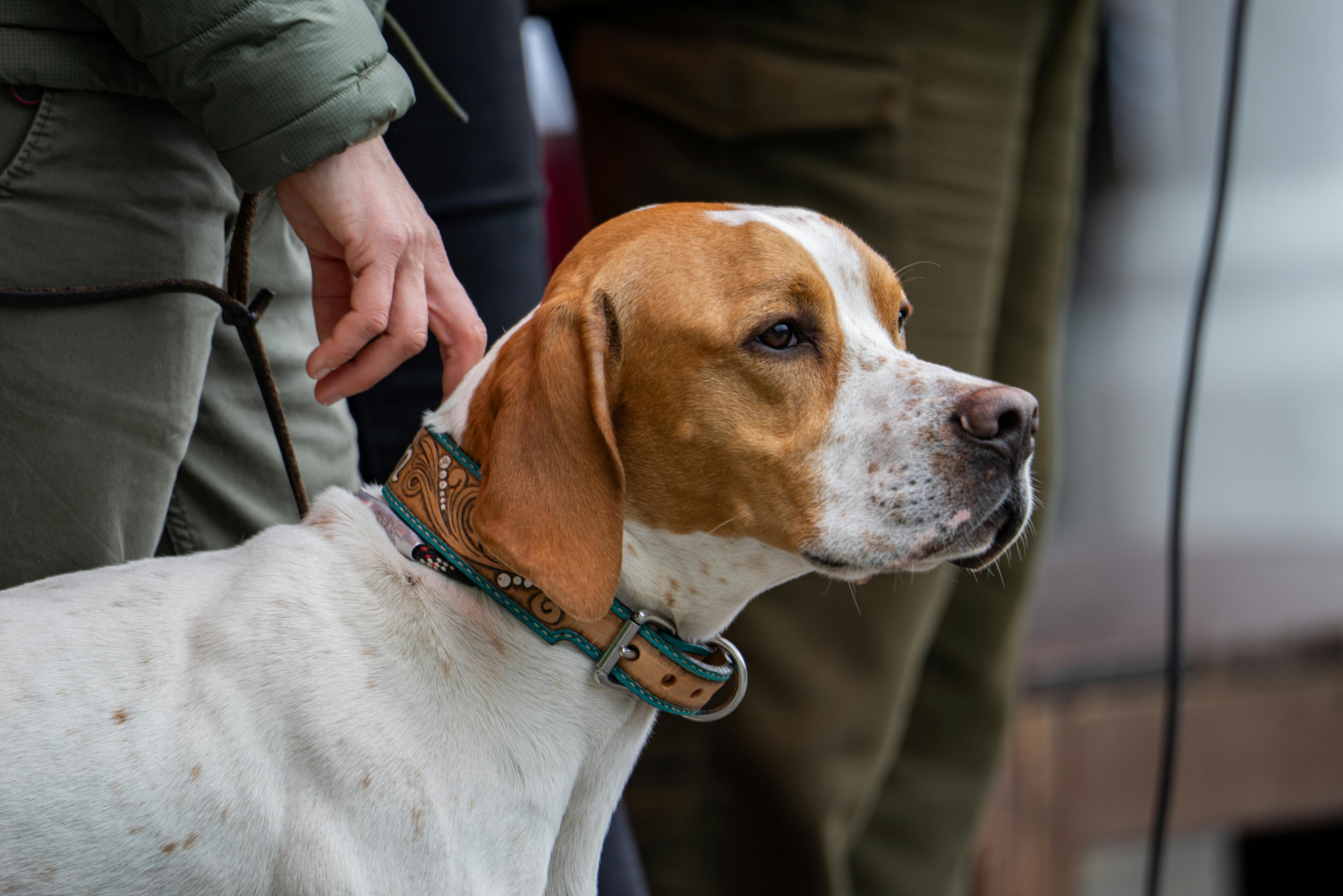 Photo: Jiri Dockal / Pexels. A pointer dog with its handler, shown as a similar hunting type; it is not a Pudelpointer.
What is a Pudelpointer?
A Pudelpointer is a German pointing and retrieving breed made from Poodle and English Pointer stock. According to Wikipedia's Pudelpointer entry, Baron "Hegewald" von Zedlitz began the work in 1881. The aim was a dog that was willing to train, intelligent, a companion in the home and fond of water and retrieving.
The breed reached North America in 1956, brought by Bodo Winterhelt, whose Winterhelle Kennel became the foundation of the line there. The Pudelpointer Club of North America was founded in Canada in 1977. Several groups now register or test the breed, including NAPPA, PCNA and VPP-GNA, and NAVHDA runs the tests most owners use to prove a dog.
Breeders have avoided AKC recognition, the same entry says, which keeps the breed in the hands of hunters. One consequence is that you will not find a Pudelpointer through a general breeder directory. You will find it through the clubs.
How big is a Pudelpointer?
The Pudelpointer stands 21 to 26 inches at the shoulder and weighs 44 to 66 pounds, per Wikipedia. PetBudget's breed data uses a modeling range of 45 to 70 pounds, which is wider at the top to leave room for large males. It treats the breed as a large dog for food, medication and boarding costs.
| Trait | Pudelpointer |
|---|---|
| Height | 21 to 26 inches |
| Weight (Wikipedia) | 44 to 66 pounds |
| Weight (PetBudget model) | 45 to 70 pounds |
| Typical lifespan in the model | 13 years |
| Exercise in the model | 90 minutes a day |
| Grooming rating (1 to 5) | 2 |
| Shedding rating (1 to 5) | 2 |
For a buyer, the size means a dog that fits in a car crate and a house, but not in a small apartment with no yard. It also means kibble for a 50-to-60-pound athlete, which is the largest single recurring cost after the premium.
Do Pudelpointers shed?
Yes, lightly to moderately. PetBudget's breed data rates Pudelpointer shedding at 2 out of 5. That is lower than the German Wirehaired Pointer, which the model rates 3, and the German Shorthaired Pointer, also 3. A harsh, dense coat holds its hair longer than a smooth coat does, so you see less on the furniture and more when you brush.
Brush weekly and expect heavier hair loss in spring and fall. A rubber brush or a slicker works on the wiry texture, and an occasional trim keeps the face and legs neat. The coat also collects burrs, so plan on a quick check after field work.
Are Pudelpointers hypoallergenic?
PetBudget's data does not flag the Pudelpointer as hypoallergenic. It does flag the Standard Poodle, which has a shedding rating of 1 and a grooming rating of 5. The Pudelpointer descends from Poodle stock, but breeding for a wiry hunting coat produced a dog that sheds more than a Poodle and needs far less grooming.
If someone in your household has allergies, do not rely on the Poodle ancestry. Spend time with the specific dog, ideally the parents too, before you commit. A breeder who hunts the dogs will usually let you meet them.
What colors do Pudelpointers come in?
Pudelpointer colors are liver, chestnut and occasionally black, says Wikipedia's breed entry, and the ideal coat is harsh, wiry and dense. Searches such as "black pudelpointer" and "pudelpointer white" are common, but the breed entry lists only liver, chestnut and occasional black, so be cautious with any listing that promises another color.
Color has no effect on cost to keep. It can affect the price of a puppy if a breeder charges more for a rarer color, so ask what the price depends on and whether the parents' health tests are the same for every puppy in the litter.
What does a Pudelpointer cost to keep?
A Pudelpointer costs about $2,586 a year and $36,063 over 13 years in PetBudget's model. The first year is $5,031, including a puppy priced at a modeled $1,100.
| Annual line | Pudelpointer |
|---|---|
| Food | $721 |
| Vet care | $700 |
| Grooming | $195 |
| Insurance | $809 |
| Supplies and toys | $161 |
| Total per year | $2,586 |
The insurance line starts from the average U.S. dog accident-and-illness plan, which is $836 a year in NAPHIA's State of the Industry highlights. PetBudget scales it to $809 for this breed.
$36,063
Modeled lifetime cost of a Pudelpointer over 13 years: $5,031 for the first year plus $2,586 for each of the next 12. Run your own version in the calculator.
What does the first year cost, and how is the lifetime built?
The first year costs $5,031, and the rest of the lifetime adds about $31,000. The first-year bill has a one-time part and a recurring part.
| First-year line | Amount |
|---|---|
| Purchase or adoption (modeled) | $1,100 |
| Initial vet visit and vaccinations | $700 |
| Starter supplies | $546 |
| Training classes | $260 |
| Food, vet care, grooming and insurance | $2,425 |
| Total | $5,031 |
Across a 13-year life the model spreads the cost like this: $5,031 for year one, $18,102 for years two to eight and $12,930 for years nine to thirteen. The sum is $36,063. Hunting dogs are rarely idle, so budget extra for a crate, field gear and test or training fees, none of which the model includes.
How does the Pudelpointer compare with other hunting breeds?
The Pudelpointer is the cheapest of the four breeds below on a yearly basis. The German Shorthaired Pointer has a lower lifetime total only because the model gives it a 12-year life against the Pudelpointer's 13.
| Breed | Annual cost | Lifetime cost | Shedding (1 to 5) | Grooming (1 to 5) |
|---|---|---|---|---|
| Pudelpointer | $2,586 | $36,063 | 2 | 2 |
| German Shorthaired Pointer | $2,685 | $34,665 | 3 | 1 |
| German Wirehaired Pointer | $2,825 | $39,170 | 3 | 2 |
| Standard Poodle | $3,038 | $41,939 | 1 | 5 |
The model gives the Pudelpointer lower insurance and vet lines than the German breeds, which is why it undercuts them on a yearly basis. That reflects PetBudget's risk scoring and not a guarantee, so get real insurance quotes. The German Shorthaired Pointer and Standard Poodle pages carry their own numbers.
Pudelpointer or German Wirehaired Pointer?
The two wire-coated pointing breeds look alike and cost within $239 a year of each other. PetBudget models the German Wirehaired Pointer at $2,825 a year and the Pudelpointer at $2,586. The German Wirehaired has a 3 shedding rating against the Pudelpointer's 2, a 50 to 70 pound weight range against 45 to 70, and the same 13-year life.
The gap comes from vet and insurance lines. The model charges $770 for vet care and $955 for insurance for the German Wirehaired, against $700 and $809 for the Pudelpointer. That reflects the model's size and risk scoring, so treat it as a guide to compare quotes and not a promise. The more practical difference is availability: the Pudelpointer is rarer in North America and has a smaller breeder base.
What health costs should you plan for?
Hip dysplasia and ear infections are the two conditions in PetBudget's data. If a hip needs surgery, MetLife's hip dysplasia surgery guide gives a range of $1,200 to $6,000, and the model uses $5,250 as the typical figure. Iowa State University's total hip replacement page lists $7,000 to $9,000 per hip for a full replacement.
Ear infections cost less per visit but recur. A dog that swims and hunts in wet cover is more exposed, so dry the ears after water and clean them on a schedule. Ask your vet how often.
Reserve $4,000 if you do not insure. That figure comes from MetLife's 2025 survey of 1,000 pet owners, in which 15% had spent $3,000 or more on an unexpected vet bill and 90% had no savings set aside for pets. The pet insurance versus emergency fund comparison helps you choose.
Where do you find a Pudelpointer puppy?
You find one through the breed clubs and hunt-test community, and you plan to wait. The registries and groups named in Wikipedia's entry, NAPPA, PCNA and VPP-GNA, are the starting points, along with NAVHDA chapters. Searches like "pudelpointer puppies near me" lead to small breeders, many of whom raise a litter or two a year.
Expect to answer questions about your plans for the dog. Many breeders prefer homes that will hunt or test the dog, and some will sell to active pet homes. Use this checklist:
- Ask which tests the parents have passed, including hip evaluations and a NAVHDA result.
- Ask how the litter is socialized and what the puppies see before they go home.
- Ask what the contract says about taking the dog back.
- Visit if you can, and meet at least the mother.
- Get insurance quotes on the puppy's age before pickup day.
Is a Pudelpointer right for you?
It suits an active household that wants a trainable, water-loving companion and a dog that can work. It does not suit a household that wants a low-effort pet. PetBudget's breed data assumes 90 minutes of exercise a day, and the breed's goals include being a companion in the home, so it wants your company as well as a run.
If you cannot find one, the Wirehaired Vizsla and Small Munsterlander are other versatile hunting breeds with comparable costs. The Vizsla vs Wirehaired Vizsla guide compares two of them.
Frequently asked questions
Is a Pudelpointer a Poodle mix?
It began as a Poodle and English Pointer cross in 1881, but it is now an established breed. A modern litter of two Pudelpointers produces Pudelpointers, not a mix. A random Poodle and pointer cross is a different thing.
How much exercise does a Pudelpointer need?
PetBudget's breed data uses 90 minutes a day for an adult in good health. The breed was built for field work and water, so runs, swims and retrieving work well.
Can a Pudelpointer live in an apartment?
It is possible if you provide long daily outings, but the size and energy make it a poor fit for most apartments. A fenced yard helps, though it never replaces your time with the dog.
Do Pudelpointers get along with children and other pets?
Wikipedia says the breed was developed to be a companion in the home as well as a hunter, which supports a family role. Temperament still depends on the individual dog and its socialization. Introduce a puppy to children and other pets early and under supervision, and ask the breeder how the parents behave around visitors.
How long do Pudelpointers live?
PetBudget uses a typical lifespan of 13 years, with a range of 12 to 14. Wikipedia's entry does not give a lifespan, so the figure is a modeled estimate and not a measured average.
Frequently asked questions
Do Pudelpointers shed?
Lightly to moderately. PetBudget's breed data rates shedding at 2 out of 5 for the Pudelpointer, which is below the 3 for the German Wirehaired Pointer. The wiry coat needs weekly brushing and occasional trimming.
Are Pudelpointers hypoallergenic?
PetBudget's data does not flag the Pudelpointer as hypoallergenic, although it flags the Standard Poodle. Allergic people should spend time with the specific dog before buying, because coats and reactions vary.
What colors do Pudelpointers come in?
Wikipedia lists liver, chestnut and occasionally black, with a harsh, wiry, dense coat as the ideal. Colors do not change the cost to keep the dog.
Is the Pudelpointer recognized by the AKC?
No. Wikipedia says breeders have avoided American Kennel Club recognition. The breed is registered through North American groups such as the Pudelpointer Club of North America and tested by NAVHDA.
See your own pet's real numbers.
Run the calculator with your breed, metro area, and care choices for a first-year, annual, and lifetime cost estimate — not a national average.
Comments
Comments are moderated before they appear. Constructive questions, corrections and first-hand pet cost experiences are welcome.
Verified Dialogue
Sort by: Chronological (earliest)Loading comments…