

Key takeaways
- The Cat Fanciers' Association says a mature male Ragdoll often reaches or exceeds 20 pounds, females are usually smaller, and the breed reaches full size and weight at four years.
- In PetBudget's data of 75 cat breeds the Ragdoll has the highest modeled lifetime cost, $22,164, and the highest insurance line, $508 a year.
- Size is not what drives that: a Ragdoll's food is only $271 a year. Its long life (15 years) and insurance premium are what push the lifetime total up.
Ragdoll cat size is large. The Cat Fanciers' Association (CFA) says a mature male often reaches or exceeds 20 pounds. Females are usually smaller, and the breed takes about four years to finish growing. The size bill is smaller than the size suggests, and this guide shows what a Ragdoll costs.
Cost figures come from PetBudget's data for 75 cat breeds. They are modeled US averages, not quotes. Weights and growth ages come from the CFA's breed profile.
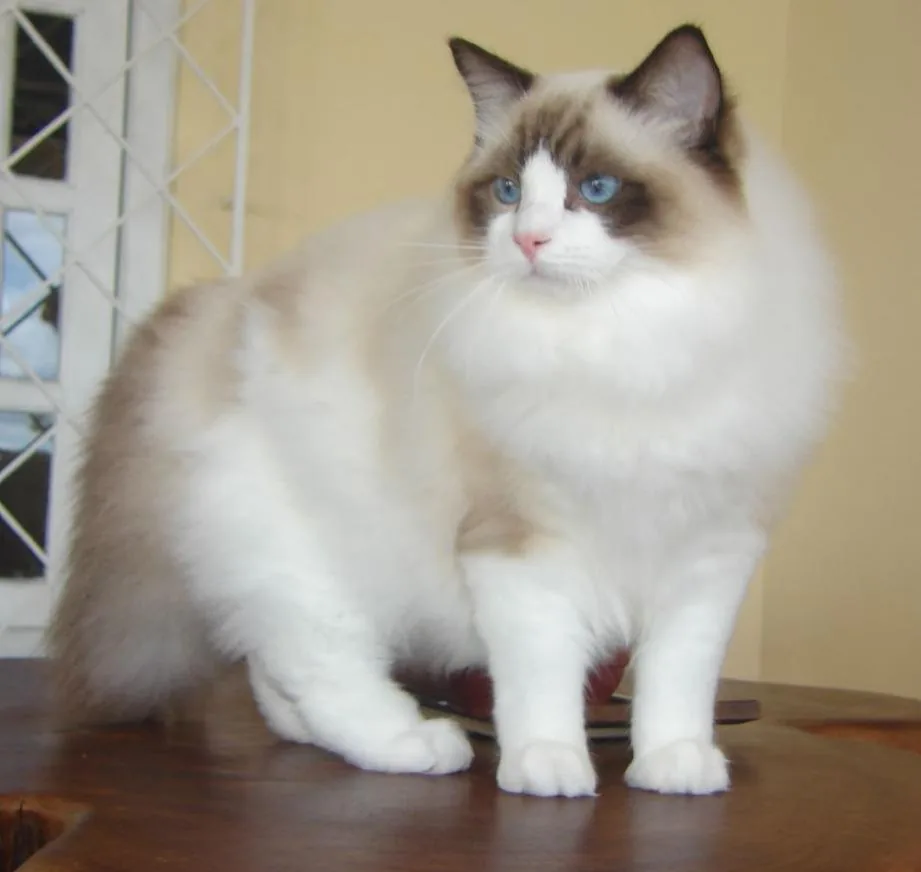 Photo: Simone Johnsson / Wikimedia Commons, CC BY-SA 2.0

How big do Ragdoll cats get?
A Ragdoll is a medium-to-large cat with heavy bones, and males can pass 20 pounds. The CFA's Ragdoll breed profile describes it as "one of the larger breeds of cat, with a broad chest, long, muscular body and sturdy boning." It adds that females are usually smaller than males.
PetBudget's breed data lists the Ragdoll at 10 to 20 lb, with a typical life of 15 years. Sex, frame and lean condition all move the weight. A cat of 15 pounds of muscle and one of 15 pounds with a belly read the same on the scale. Their health outlook is not the same.
The Ragdoll is large but not the largest. Of the 75 cats in the data, 15 are in the large class. The Maine Coon (10 to 25 lb), Savannah (12 to 25 lb) and Chausie (15 to 25 lb) all have higher top weights. The median top weight across all 75 breeds is 12 lb.
At what age is a Ragdoll fully grown?
A Ragdoll is fully grown at about four years old. The CFA says the breed is "slow-maturing, reaching full coat color at two years, and full size and weight at four." Its breed standard gives full coat and color at about three years.
That timeline is longer than for most cats, so a Ragdoll kitten keeps filling out for years after a shorthair has stopped. Three practical points follow:
- Weigh the cat on a schedule. A cat still growing at age three can gain weight that is growth, and weight that is fat, with no easy way to tell by eye.
- Do not judge the adult size from the kitten. The CFA gives no growth chart by month, so any month-by-month table you find online is an estimate, not a breed standard.
- Expect the food bill to rise for longer. A cat that grows for four years eats more for four years, though the model prices food on adult size.
For feeding amounts by weight, use the cat calorie calculator. For what a healthy weight looks like, see the healthy cat weight chart. For the purchase side of a Ragdoll kitten, the Ragdoll price guide has the breeder and adoption ranges.
How does a Ragdoll compare with other large cats?
A Ragdoll sits in the middle of the large cats for weight and at the top for cost. The table compares ten breeds from PetBudget's data, from the small Singapura to the Maine Coon.
| Breed | Weight | Typical life | Food per year | Insurance per year | Yearly total | Lifetime |
|---|---|---|---|---|---|---|
| Ragdoll | 10-20 lb | 15 years | $271 | $508 | $1,314 | $22,164 |
| Savannah | 12-25 lb | 16 years | $423 | $435 | $1,288 | $22,162 |
| Norwegian Forest Cat | 9-20 lb | 15 years | $282 | $435 | $1,279 | $20,739 |
| Persian | 7-12 lb | 14 years | $193 | $471 | $1,299 | $20,696 |
| Maine Coon | 10-25 lb | 13 years | $325 | $435 | $1,322 | $19,740 |
| British Shorthair | 9-18 lb | 15 years | $251 | $435 | $1,152 | $18,834 |
| Bengal | 8-18 lb | 14 years | $325 | $435 | $1,190 | $18,214 |
| American Shorthair | 8-15 lb | 17 years | $237 | $314 | $912 | $16,914 |
| Siamese | 6-12 lb | 13 years | $247 | $402 | $1,049 | $14,947 |
| Singapura | 4-8 lb | 13 years | $164 | $307 | $817 | $11,693 |
The yearly total also includes routine vet care, grooming and supplies. A Ragdoll's food bill is 65% above the Singapura's and 17% below the Maine Coon's. The Persian weighs at most 12 lb and still costs $1,299 a year, only $15 less than the Ragdoll, because its grooming ($228) and insurance ($471) are high.
Why does the Ragdoll cost the most over a lifetime?
The Ragdoll costs the most because of insurance and lifespan, not size. At $22,164 its modeled lifetime cost is the highest of the 75 cat breeds, ahead of the Savannah at $22,162 by two dollars. The median cat in the data totals $14,930 over a lifetime, so a Ragdoll costs 48% more.
Three lines explain it:
- Insurance of $508 a year is the highest premium of any cat in the data. The Maine Coon, Norwegian Forest Cat and Savannah are all at $435.
- A 15-year typical life is a year longer than the 14-year median for cats, so the high yearly cost repeats for longer.
- Routine vet care of $336 is also the highest in the group, above the $303 of most large cats.
Food adds little. A Ragdoll's $271 is $57 above the median cat's $214, which is far smaller than the $201 insurance gap between a Ragdoll and a Singapura. Size is the least important of the four.
$22,164
The modeled lifetime cost of a Ragdoll in PetBudget's data, $7,234 above the median cat and $10,471 above a Singapura. Run your own cat, age and metro on the calculator.
The Ragdoll's first year is $3,768 in the model, against $2,322 for an American Shorthair. The gap includes the one-time purchase price. For where the Ragdoll falls among other expensive cats, see most expensive cat breeds and least expensive cat breeds.
What health problems come with a large Ragdoll?
Two matter most: heart disease and weight. Both are named by the CFA, and both show up in the insurance line.
Hypertrophic cardiomyopathy (HCM). The CFA says one hereditary health issue has been found in the breed, hypertrophic cardiomyopathy, and that breeders now routinely test for it and are working to remove carrier cats from the gene pool. Ask any Ragdoll kitten breeder for the test results of both parents. Diagnosis is a bill of its own: MetLife Pet Insurance says a single electrocardiogram can cost $200 to $400 and the combined diagnosis often comes to $1,000 to $1,500. It describes treatment as relatively cheap, with beta blockers costing as little as $0.19 a tablet.
Obesity. The CFA says Ragdolls may be at risk for obesity and advises owners to monitor portion sizes. A heavy frame hides early weight gain. A cat that is 18 lb and lean is healthy, while one that is 18 lb and soft is carrying the extra weight on a heart the breed already has to watch.
| Health item | Published figure | Source |
|---|---|---|
| Electrocardiogram | $200 to $400 | MetLife Pet Insurance, March 2024 |
| Full heart disease diagnosis | $1,000 to $1,500 | MetLife Pet Insurance, March 2024 |
| Beta blocker tablet | from $0.19 | MetLife Pet Insurance, March 2024 |
| Full adult size and weight | about 4 years | Cat Fanciers' Association |
How to budget for a Ragdoll
Budget for a Ragdoll by planning for 15 years, a premium that is the top of the cat range and a diagnostic reserve. Follow these steps.
- Use $1,314 a year as the baseline. That is the model's yearly cost after year one, excluding emergencies. Adjust it for your metro on the calculator.
- Price insurance before you buy. The model's Ragdoll premium is $508 a year, so get a real quote for a kitten and compare it with how much a cat costs.
- Hold a $1,500 heart-check reserve. The top of MetLife's $1,000 to $1,500 diagnosis range covers one full cardiac work-up if a vet finds a murmur.
- Weigh the cat every month. Do it until age four, and write the number down.
- Ask for HCM test results. The CFA says breeders routinely test, so a breeder who cannot show results needs questioning.
The grooming line is the smallest of the five. The CFA recommends combing once or twice a week with a steel comb, and the model prices grooming at $96 a year, so a Ragdoll's semi-long coat costs less than a Persian's $228.
What this does not tell you
PetBudget models a typical healthy cat at average US prices with one insurance premium per breed. A neutered indoor Ragdoll on a measured diet will cost less than $1,314. One with early heart disease will cost far more, and the diagnosis range above is only the start. The CFA publishes no growth chart by month, so this guide gives the maturity ages it states and nothing finer.
Frequently asked questions
How big do Ragdoll cats get?
The Cat Fanciers' Association calls the Ragdoll one of the larger cat breeds and says it is not unusual for a mature male to reach or exceed 20 pounds. Females are usually smaller. PetBudget's breed data lists a 10 to 20 lb range.
At what age is a Ragdoll fully grown?
The CFA says Ragdolls are slow-maturing, reaching full coat color at two years and full size and weight at four. A Ragdoll kitten can therefore still be filling out well after most other cats have stopped.
Are Ragdolls bigger than Maine Coons?
Usually not. PetBudget lists the Maine Coon at 10 to 25 lb and the Ragdoll at 10 to 20 lb. The Maine Coon's food bill is also higher, $325 a year against the Ragdoll's $271.
Do Ragdolls get fat easily?
The CFA says Ragdolls may be at risk for obesity and tells owners to monitor portion sizes. A big frame makes a gain harder to see, so weigh the cat on a scale rather than judging by size alone.
Is a Ragdoll expensive to keep?
In PetBudget's model a Ragdoll costs $1,314 a year after the first year, against a median of $984 across 75 cat breeds. Over its 15-year typical life that is $22,164, the highest lifetime figure of any cat in the data.
See your own pet's real numbers.
Run the calculator with your breed, metro area, and care choices for a first-year, annual, and lifetime cost estimate — not a national average.
Comments
Comments are moderated before they appear. Constructive questions, corrections and first-hand pet cost experiences are welcome.
Verified Dialogue
Sort by: Chronological (earliest)Loading comments…