

Key takeaways
- The Stabyhoun is a 40 to 55 pound Dutch gundog that PetBudget models at $2,361 a year and $35,309 over 14 years, with most of the risk in what a puppy inherits.
- The breed's most unusual inherited problem is cerebral dysfunction, a recessive brain disorder found in 2009 for which a DNA test exists, and the Ameri-Can Stabyhoun Association forbids mating two carriers.
- Ask for hip and elbow results, a cerebral dysfunction result and a von Willebrand result on both parents, because Stabyhouns are rare enough that a poorly planned litter is a real risk.
A Stabyhoun is a medium Dutch gundog that costs about $2,361 a year to keep, and its biggest cost risk is the pedigree you buy into. Only a few thousand exist worldwide, and the gene pool is small. That makes health testing the single most useful thing a buyer can ask about, and the quickest way to tell a careful breeder from a casual one.
This guide lists each Stabyhoun health condition, who tests for it, what a failed test means and what each one can cost. The cost figures for the breed itself are on the Stabyhoun breed page.
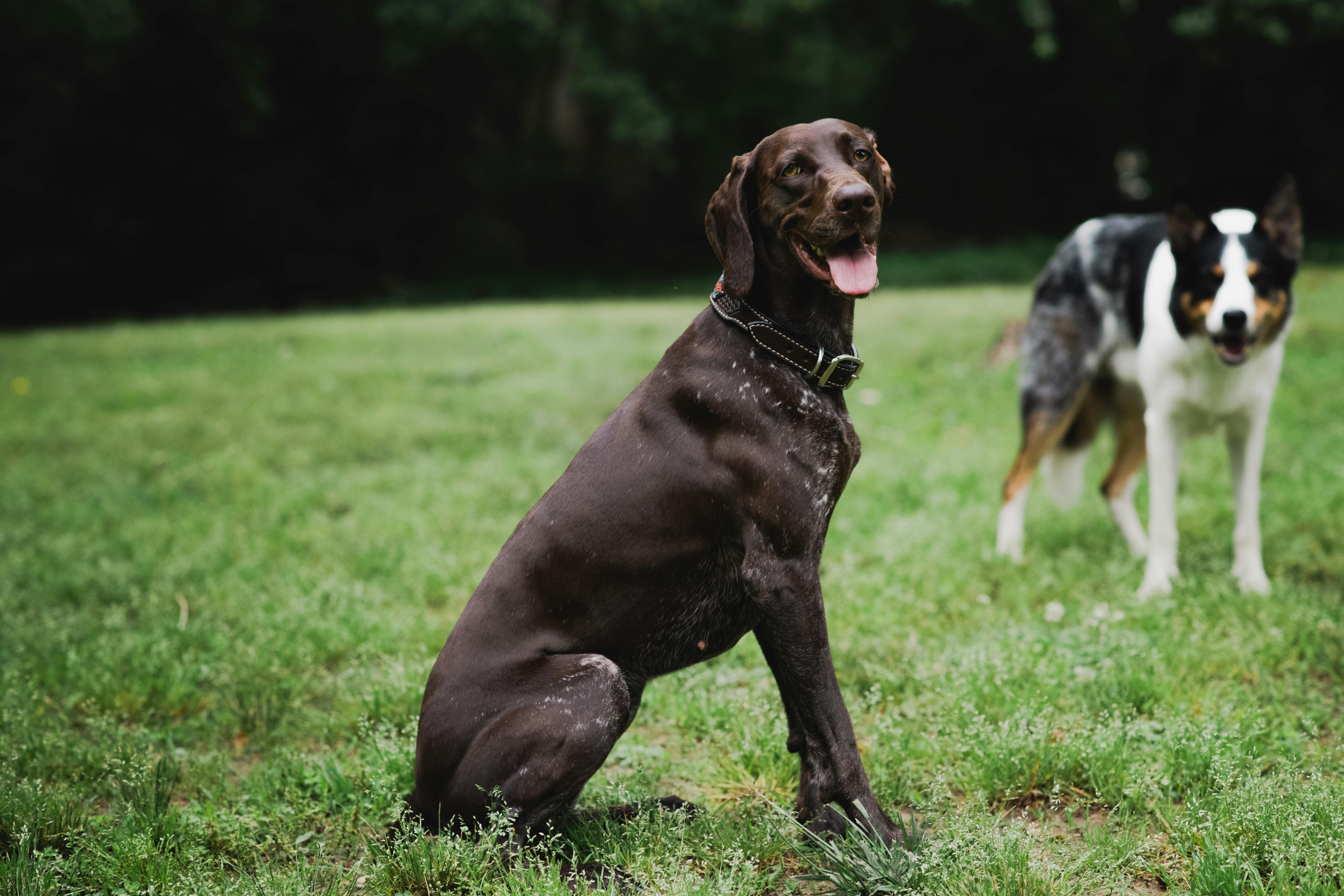 Photo: Brixiv / Pexels. A German Shorthaired Pointer shown as a similar gundog type; it is not a Stabyhoun.
What is a Stabyhoun?
A Stabyhoun is a Dutch farm dog from Friesland that points game, retrieves and catches small animals. Wikipedia's Stabyhoun entry says the breed appears in Dutch writing in the early 1800s, was officially recognized in 1942 and left the Netherlands in the 2000s. Crossbreeding with the related Wetterhoun stopped to prevent extinction.
Males stand about 21 inches and weigh 50 to 55 pounds. Females are about 20 inches and 45 pounds. The coat is long, sleek and soft, usually black and white, and the dog sheds twice a year. PetBudget rates temperament as gentle, biddable and calm indoors.
The registries are small. The AKC added the breed to its Foundation Stock Service on April 12, 2005, approved it for companion events from July 1, 2008 and for performance events from July 1, 2011. That makes it a recorded breed that can compete, though it is not fully recognized.
Why does health testing matter more in a rare breed?
A small gene pool concentrates inherited disease. Wikipedia says only a few thousand Stabyhouns exist worldwide, and the breed club runs a diversity project because of it. When every litter draws from the same few lines, one carrier of a recessive condition can reach many dogs before anyone knows.
For a buyer, that changes the question from "is this dog healthy?" to "what has been tested, and what do the results say?" A breeder who tests every litter gives you written answers. A breeder who does not is asking you to take the risk.
Which Stabyhoun health conditions should you know about?
Eight conditions are documented in the breed. The table summarizes what the UK Stabyhoun club's health page reports for each one, plus what a US buyer can ask for.
| Condition | How it is inherited | Test | What to ask for |
|---|---|---|---|
| Cerebral dysfunction | Autosomal recessive | DNA test | Result on both parents, or on the puppy |
| Von Willebrand disease Type I | Autosomal dominant, incomplete penetrance | DNA test | Result on both parents |
| Hip dysplasia | Genes and environment | X-ray | Hip grades on both parents |
| Elbow dysplasia | Genes and environment | X-ray | Elbow grades on both parents |
| Epilepsy | Can be hereditary | None described | Seizure history in the pedigree |
| Patent ductus arteriosus | Partly genetic | No reliable DNA test yet | Heart check at 6 to 7 weeks |
| Steroid-responsive meningitis-arteritis | Not stated | None described | Litter history |
| Paw pad disorders | Not stated | None described | Nothing specific |
The UK club's page is a breed-club source and not a veterinary study, so treat the frequencies below as club reports.
What is cerebral dysfunction in Stabyhouns?
Cerebral dysfunction is a recessive neurological disorder first found in the breed in 2009, and affected puppies usually die within a few months. The UK club says signs start around 6 weeks, and a DNA test has been mandatory for UK breeding dogs since the markers were found in April 2015.
Because it is recessive, a puppy is affected only if both parents carry the mutation. That is why the Ameri-Can Stabyhoun Association's code of ethics says two carriers cannot be mated, and one partner must be clear. It also requires every puppy in a litter to be DNA tested with EMBARK Breeder testing, preferably in the first week, and results must go to the puppy buyer.
Some summaries describe a Stabyhoun polyneuropathy, but I could not find a source or a DNA test for one. The inherited neurological disorder with a documented test is cerebral dysfunction. If a breeder claims a polyneuropathy test, ask for the lab report.
How common are hip, elbow and epilepsy problems?
They are reported at low rates in the Netherlands, though the figures come from the UK club and are not a registry audit. The UK page says radiographic hip dysplasia is seen about 3 to 4 times a year in Holland and elbow dysplasia about 3 to 4 times a year. It says epilepsy occurs about 4 times a year, roughly 1% of the population, and usually appears at 2 to 3 years.
A low frequency does not mean zero cost for your dog. If your dog is the one in a hundred, the bill is large:
| Condition | Treatment cost | Source |
|---|---|---|
| Hip dysplasia, femoral head removal | $1,200 to $2,500 per hip | MetLife |
| Hip dysplasia, total hip replacement | $3,500 to $7,000 or more per hip | MetLife |
| Elbow dysplasia, surgery | $1,500 to $4,000 per elbow | Embrace |
| Epilepsy, medication | $51 to $75 a month for the median owner | dvm360 |
The dvm360 report says 10% of owners spent more than $200 a month on medication. Over a year, the median medication cost works out to about $612 to $900 before bloodwork.
What does von Willebrand disease mean for a Stabyhoun?
Von Willebrand disease is a bleeding disorder, and the UK club says roughly a quarter of the population is free of it, half are carriers and a quarter are at risk. It adds that clinical symptoms are rarely reported. The disease is autosomal dominant with incomplete penetrance, so other factors must be present before a dog bleeds abnormally.
The practical advice is simple. Ask for the dog's result. If it is a carrier or at-risk dog, tell the surgeon before any procedure, including a spay, a neuter or a dental extraction. The Ameri-Can code of ethics page does not mention vWD, so ask your breeder directly.
What does a Stabyhoun cost to keep?
A Stabyhoun costs about $2,361 a year and $35,309 over a 14-year life in PetBudget's model. The first year is $4,616, including a modeled puppy price of $1,000 that is an estimate and not a quoted price.
| Annual line | Stabyhoun |
|---|---|
| Food | $500 |
| Vet care | $660 |
| Grooming | $312 |
| Insurance | $749 |
| Supplies and toys | $140 |
| Total per year | $2,361 |
$3,000
PetBudget's emergency reserve for a Stabyhoun, enough for one elbow surgery at the middle of Embrace's $1,500 to $4,000 range. Build your own plan in the calculator.
The $749 insurance line is a medium-dog scaling of the $836 average dog plan in NAPHIA's State of the Industry highlights. Insurers may exclude conditions found before enrollment, so get a quote before the puppy comes home.
What do the cerebral dysfunction results mean for a litter?
A recessive disorder follows simple odds, and the pairing tells you the risk before any puppy is born. The table shows the expected outcome for each pairing of dogs that are clear or carriers. Percentages are the standard Mendelian expectations for a recessive trait, not Stabyhoun-specific statistics.
| Parents | Affected puppies | Carrier puppies | Clear puppies |
|---|---|---|---|
| Clear and clear | 0% | 0% | 100% |
| Clear and carrier | 0% | 50% | 50% |
| Carrier and carrier | 25% | 50% | 25% |
The code of ethics bans the last row. A clear and carrier pairing is allowed, and it produces carrier puppies that can be bred later to clear partners. That is how a small breed keeps useful lines without producing affected dogs, and it is why a puppy buyer should read the litter result and not only the parents'.
What does the first year cost, and what does the lifetime look like?
The first year costs $4,616, and later years cost $2,361. The model assumes a puppy bought from a health-testing breeder, so the purchase price is an estimate that can rise with testing and demand.
| First-year line | Amount |
|---|---|
| Purchase or adoption (modeled) | $1,000 |
| Initial vet visit and vaccinations | $660 |
| Starter supplies | $475 |
| Training classes | $260 |
| Food, vet care, grooming and insurance | $2,221 |
| Total | $4,616 |
Adding the later years gives $14,060 by year 5, $25,865 by year 10 and $35,309 by year 14. The first-year total is lower than a Wetterhoun's $5,146 because the dog is 15 to 20 pounds lighter and eats less.
What should a US buyer do about price and shipping?
Ask for the full price in writing before you pay a deposit. The modeled $1,000 purchase price is a placeholder, and I could not find a published price for Stabyhoun puppies from the club or breeders. The cost to a US buyer has up to four parts:
- The puppy price, which depends on the breeder and the litter.
- Health testing, which a careful breeder includes or passes on.
- Travel or shipping, which varies by route and airline.
- A vet exam within days of arrival, which a new owner should book in advance.
Compare quotes from at least two breeders, and avoid any seller who offers a rare breed at a low price with no tests. A cheap Stabyhoun with no results can cost thousands more than a tested one if a genetic problem appears. Our pet insurance for a puppy guide explains what a policy may exclude.
How does it compare with similar gundogs?
The Stabyhoun sits between the Brittany-sized pointers and the larger Wetterhoun on cost. It costs $120 a year more than a Brittany or Small Munsterlander, and $340 less than a Wetterhoun.
| Breed | Annual cost | Lifetime cost | Weight | Grooming cost |
|---|---|---|---|---|
| Stabyhoun | $2,361 | $35,309 | 40 to 55 pounds | $312 |
| Wetterhoun | $2,701 | $37,558 | 55 to 77 pounds | $312 |
| Brittany | $2,241 | $31,388 | 30 to 40 pounds | $195 |
| Small Munsterlander | $2,241 | $31,388 | 30 to 40 pounds | $195 |
The difference comes from size and a longer coat. The Stabyhoun eats more than the Brittany and needs more brushing. See the Wetterhoun, Brittany and Small Munsterlander pages, and our Wetterhoun buying guide for the closest relative.
How do you find Stabyhoun puppies and breeders?
Start with the breed club and expect to wait. The Ameri-Can Stabyhoun Association lists a puppy waitlist, and Dutch breeders work under the NVSW club. Wikipedia reports an average litter of seven and limits on how often a bitch can be bred, so litters are few.
Use this checklist when you speak to a Stabyhoun breeder:
- Ask for written hip and elbow results on both parents.
- Ask for cerebral dysfunction results, and confirm the litter is EMBARK tested.
- Ask for the vWD result and what it means for surgery.
- Ask about epilepsy, SRMA and heart murmurs in the pedigree.
- Ask for the contract, including what happens if a genetic problem appears.
- Ask the age at which the puppy goes home.
If you import from the Netherlands, the CDC rule requires a dog to be at least 6 months old and microchipped, and the Netherlands is not on the CDC's high-risk list. Our Wetterhoun import guide walks through the form.
Is a Stabyhoun right for you?
It suits an active household that wants a gentle, people-focused dog and can accept a wait for a puppy. It does not suit a buyer who needs a puppy next month, or one who will not read a health report. The Stabyhoun is calm indoors, but PetBudget's data assumes 60 minutes of exercise a day, so a bored dog will find its own work.
Think of the health tests as part of the price. A breeder who spends money on DNA panels, X-rays and heart checks is passing on lower risk, and a wait of several months is the cost of getting it. If the wait is too long, a Brittany or Small Munsterlander has a similar yearly cost and is a far more common breed.
Frequently asked questions
Is the Stabyhoun a good family dog?
PetBudget rates the temperament as gentle, biddable, loyal and calm indoors. Temperament still depends on the individual, so meet the parents.
How much exercise does a Stabyhoun need?
PetBudget uses 60 minutes a day for an adult. The breed was a working farm dog, so it enjoys scent work, retrieving and long walks.
Do Stabyhouns shed?
Yes. Wikipedia says they shed twice a year, and PetBudget rates shedding at 3 out of 5. The coat does not curl, so brushing a few times a week is enough.
Is the Stabyhoun hypoallergenic?
PetBudget's data does not flag it as hypoallergenic. If allergies are a concern, spend time with the specific dog.
Frequently asked questions
What health problems do Stabyhouns have?
Wikipedia lists patent ductus arteriosus, epilepsy, elbow dysplasia, hip dysplasia and Type 1 von Willebrand disease as known congenital conditions. The UK breed club adds cerebral dysfunction and steroid-responsive meningitis-arteritis.
Is there a DNA test for Stabyhouns?
Yes, for cerebral dysfunction and for von Willebrand disease. The Ameri-Can Stabyhoun Association requires EMBARK Breeder testing for every puppy in a litter. There is no reliable test yet for patent ductus arteriosus.
How long do Stabyhouns live?
Wikipedia gives an average of 13 to 15 years. PetBudget models 14 years.
Where do I find Stabyhoun puppies?
Through the Ameri-Can Stabyhoun Association in the US and Canada, which keeps a puppy waitlist, or through Dutch breeders under the NVSW club. Imported dogs must be at least 6 months old to enter the US.
See your own pet's real numbers.
Run the calculator with your breed, metro area, and care choices for a first-year, annual, and lifetime cost estimate — not a national average.
Comments
Comments are moderated before they appear. Constructive questions, corrections and first-hand pet cost experiences are welcome.
Verified Dialogue
Sort by: Chronological (earliest)Loading comments…