

Key takeaways
- Kittens do best on three meals a day until six months, twice daily until one year, and adult cats on one or two meals, per the Cornell Feline Health Center.
- Leaving food out all day is not recommended by the Merck Veterinary Manual, and 61% of U.S. cats were already overweight or obese in the 2022 APOP survey.
- Food is only about $0.59 a day for a Domestic Shorthair in PetBudget's model, so a schedule is a health decision first and a budget decision second.
Most adult cats do best on two meals a day, spaced evenly. Kittens need three meals a day until about six months. A good cat feeding schedule matches age, weight and your own routine, and it takes the guesswork out of "how often should you feed a cat." This guide covers the schedule by life stage, sample daily plans, wet and dry food timing, and the risks of getting it wrong.
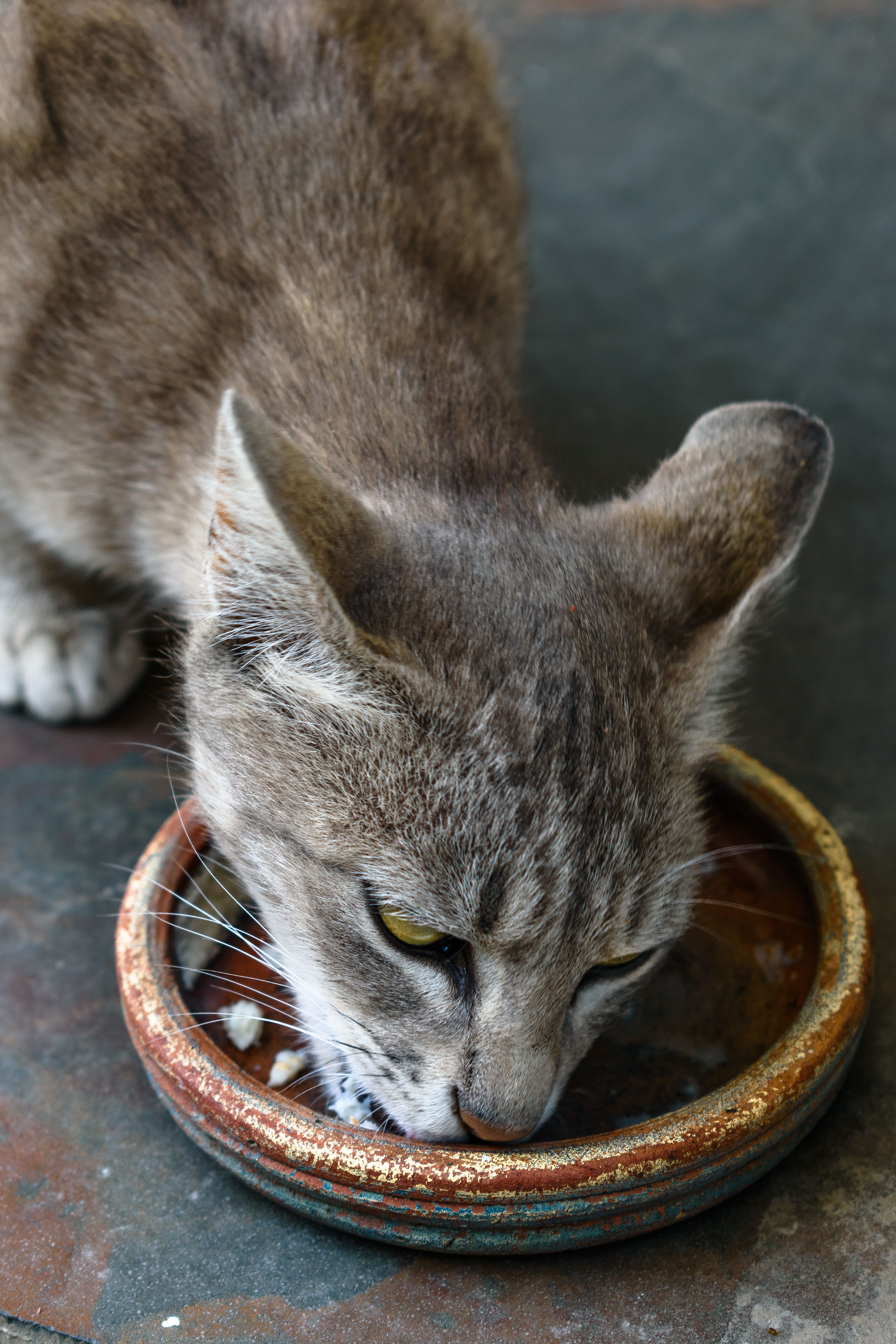 Photo: chalta-phirta / Pexels
Latest news: cat weight and feeding in 2026
- A new weight survey is under way. The Association for Pet Obesity Prevention designated October 2026 a prevalence study year, during World Pet Obesity Month, according to APOP's announcement. Clinics collect body condition scores with one method. No new rates are published yet, so 61% overweight or obese cats remains the latest figure.
- New diabetes guidelines. The 2026 AAHA feline diabetes guidelines, covered by dvm360 on June 26, 2026, recommend oral SGLT2 inhibitors as first-line therapy for many newly diagnosed cats. They say to keep the usual diet for the first two weeks.
What it means for you: if your cat has diabetes, your vet sets meal times around treatment. For every other cat, a steady two-meal schedule is the simplest weight control.
How often should you feed a cat?
Feed adult cats once or twice a day, and kittens three times a day. If you wonder how often should my cat eat, the short answer is twice a day for most adults. The Cornell Feline Health Center feeding guide says kittens under six months usually do best on three meals. It says twice daily is generally best from six months to a year. It says adults can eat once or twice a day.
The Merck Veterinary Manual's cat nutrition page is slightly stricter for the youngest kittens. It recommends three to four meals a day under four months old. It also says most adult cats can be fed twice a day and stay at a good weight.
| Life stage | Meals per day | What the sources say |
|---|---|---|
| Under 4 months | 3-4 | Merck: multiple small meals while the kitten is very young |
| 4 to 6 months | 3 | Cornell: three meals a day until six months |
| 6 to 12 months | 2 | Cornell: twice daily is generally best |
| Adult (1 year and up) | 1-2 | Cornell: once or twice; Merck: most cats twice |
| Senior (10 and older) | 1-2 | Cornell: keep the adult schedule unless a vet advises otherwise |
Kittens should stay on kitten food until they are about 9 to 12 months old, per Merck. Switch to adult food once growth ends, then use the adult meal count.
Sample cat feeding schedule by life stage
A cat feeding schedule only works if you can keep it on a normal week. The chart below shows four patterns. The clock times are PetBudget examples, built on the meal counts from Cornell and Merck. They are not prescribed hours.
Three ideas hold across all four rows:
- Anchor the first meal to your wake-up time. Cats learn routines fast and will wait at the bowl.
- Space the last meal well away from the first. Two meals about 12 hours apart leaves no long gap for either one.
- Keep the times steady on weekends. A cat fed at 7 a.m. on weekdays and 10 a.m. on Saturday will wake you at 7.
Cat feeding plan for different households
Your routine matters more than any clock time. Match the plan to the person who actually fills the bowl.
| Situation | Practical plan | Why it works |
|---|---|---|
| Works a 9-to-5 day | Breakfast before leaving, dinner when home | Fits the two-meal pattern most cats do well on |
| Shift worker | Anchor meals to your own wake time, not the clock | Keeps the gap between meals even |
| Begging between meals | Split the same daily food into three or four small meals | Same calories, more eating events |
| Several cats | Feed in separate spots at the same time | Keeps portions measurable per cat |
| Cat on diabetes medication | Follow the meal times your vet sets | Insulin timing depends on meals |
| Senior cat | Keep the adult schedule unless your vet changes it | Per Cornell, no automatic change at 10 |
The AAFP and ISFM feline feeding consensus statement supports the begging fix. It suggests dividing the daily allowance into several small meals. It also recommends puzzle feeders and automatic feeders to support that pattern. A timed feeder can cover a late dinner. It should not replace a daily look at how your cat eats.
If your cat is on medication, ask the vet to write the meal times into the plan. Do not shift a medicated cat's schedule on your own.
How often do cats need to eat wet food and dry food?
Wet and dry food follow the same meal counts. The difference is how long the food can sit out. Cornell says wet food is about 70 to 80 percent water and can be fed alongside dry food or in its place. Merck adds that wet food helps a cat get enough water, and many veterinarians recommend it for that reason.
Practical rules for mixing the two:
- Count both toward the total. Wet and dry food both add calories. Split the day's calories, not the day's servings.
- Give wet food at set meals. Remove what is left once the meal is over.
- Replace dry food daily. Cornell says any food left out should be swapped for fresh food every day.
Our cat water guide explains how much a cat drinks on kibble versus canned food.
How much dry food should a cat eat a day?
A cat's dry food portion depends on calories per cup, not on a fixed number of cups. Our full cat feeding amounts guide walks through the formula. Here the point is how to split the result across meals.
A neutered 10-pound adult needs about 260 calories a day, using the resting energy formula and the 1.2 multiplier in the Merck Veterinary Manual daily energy table. If the dry food has 400 calories per cup, that is about 0.65 cup a day.
| Meals per day | Calories per meal | Dry food per meal (400 cal per cup) |
|---|---|---|
| 1 | 260 | About 0.65 cup |
| 2 | 130 | About 0.33 cup |
| 3 | 87 | About 0.22 cup |
| 4 | 65 | About 0.16 cup |
Use a measuring cup or a kitchen scale, not a scoop. Your food's label sets the real calories per cup. The calorie math is the same one used in our cat calorie calculator guide.
Wet and dry food together: a sample day
Mixing both foods works if the calories add up. Take the 260-calorie cat from the section above and split the day into two equal meals of 130 calories. Each meal can be one 3-ounce can of wet food at 73 calories plus about 0.14 cup of dry food at 57 calories.
| Meal | Wet food | Dry food (400 cal per cup) | Meal total |
|---|---|---|---|
| Breakfast, 7 a.m. | One 3-oz can, 73 cal | About 0.14 cup, 57 cal | 130 cal |
| Dinner, 7 p.m. | One 3-oz can, 73 cal | About 0.14 cup, 57 cal | 130 cal |
| Day total | Two cans, 146 cal | About 0.28 cup, 114 cal | 260 cal |
The can size and calories are example label values. Read your own labels, then swap the numbers. Subtract treat calories from the dry portion so the daily total stays the same.
Kitten feeding schedule: why small cats eat so much
A kitten eats about as many calories as a cat more than twice its weight. The Merck energy table lists a multiplier of 2.5 times resting energy for kittens. It lists 1.2 for neutered adults, 1.4 for intact adults and 1.0 for adults prone to obesity. Resting energy is 70 times body weight in kilograms to the 0.75 power.
| Cat | Weight | Multiplier | Calories a day |
|---|---|---|---|
| Kitten | 4 lb | 2.5 | About 273 |
| Neutered adult | 10 lb | 1.2 | About 261 |
| Intact adult | 10 lb | 1.4 | About 305 |
| Obesity-prone adult | 10 lb | 1.0 | About 218 |
A 4-pound kitten needs about as many calories as a neutered 10-pound adult. That is why Cornell and Merck spread kitten food over three or four meals. Three meals of about 91 calories each cover the 273 calories. Merck's table also notes that kittens can alternatively be fed free choice, so a kitten's plan can be looser than an adult's.
Switch from kitten food to adult food at about 9 to 12 months, per Merck. At that point, cut the multiplier from 2.5 to 1.2 for a neutered cat. The calorie target drops by roughly half, even though the cat's weight has barely changed. Missing this step is an easy way for a young cat to gain weight.
Free feeding versus scheduled meals
Scheduled meals give you the control that free feeding lacks. Merck says leaving food out all the time is not recommended because it can lead to overeating. Cornell says free feeding may work for some cats but can cause weight gain in others.
That matters because weight is the main feline feeding problem in the U.S. The Association for Pet Obesity Prevention's 2022 survey found that 61% of cats were overweight or obese. Of those, 28% were overweight and 33% were obese.
61%
Share of U.S. cats that were overweight or obese in the 2022 APOP prevalence survey. Weigh your cat's food, and check what the healthy cat weight chart says about your cat.
Owners often do not see it. The same survey found that 28% of owners of overweight or obese cats called their cat normal, and 7% of owners of obese cats did. Our healthy cat weight chart shows how to score your cat's body condition yourself.
Cornell lists what excess weight costs a cat. Obesity there means body weight 20% or more above normal.
The same Cornell page says obese cats are twice as likely to die in middle age, which it puts at six to 12 years. A schedule that stops grazing is the simplest fix.
What happens if a cat skips meals
A cat that stops eating needs a vet fast. PetMD's hepatic lipidosis guide says fatty liver disease can begin within just a few days of not eating. It advises calling a vet if a cat goes without food for more than a day.
The risk is highest in overweight, middle-aged cats. Signs include poor appetite, rapid weight loss, vomiting, lethargy and yellow skin or eyes. PetMD says treatment centers on nutritional support and hydration, often with a feeding tube for a month or two. It says as many as 80% of treated cats survive.
Treat these as call-the-vet moments:
- A meal skipped twice in a row.
- A cat that sniffs food and walks away.
- A sudden change in how fast your cat eats.
- Vomiting or yellowing of the gums or eyes with any appetite loss.
A fussy cat that eats everything an hour later is different from a cat that stops. Log what your cat eats for a few days if you are unsure. Our vet visit cost guide shows what an exam typically costs.
How to move from free feeding to a feeding schedule
Switch gradually, because cats resist a sudden change. These steps work for most households.
- Weigh your cat and measure the day's food. Use the calorie target above. Put the total in a labeled container each morning.
- Pick two meal times you can keep. Choose a morning and an evening time.
- Serve the first meal and pick up leftovers after a set time. Cats learn that food appears at certain times.
- Expect some complaining. Do not give extra food in response. Add a small play session or a puzzle feeder instead.
- Recheck weight every few weeks. Adjust the daily total, not the number of treats.
If your cat still seems hungry, split the same calories into three small meals. This keeps the total the same and adds one more eating event.
Common feeding schedule problems and fixes
Most schedule problems come from timing and speed, not from the food itself. These fixes match the guidance above.
| Problem | Fix | Why it helps |
|---|---|---|
| Cat wakes you before dawn | Serve breakfast only when you get up | Waking you stops paying off |
| Cat gulps its food | Use a puzzle feeder or split the meal | The AAFP and ISFM statement endorses puzzle feeders |
| Wet food dries in the bowl | Pick it up after the meal | Cornell says leftovers must be replaced with fresh food daily |
| Cats steal each other's food | Feed in separate rooms at the same time | Each cat's portion stays measurable |
| Cat still begs after dinner | Split the same calories into more small meals | Total calories stay the same |
Keep a weekly log for two weeks. Write the time, the amount and any leftovers. The log shows whether a problem is real or only a habit, and it gives your vet useful numbers.
What a feeding schedule costs
Feeding a cat on a schedule costs the same as feeding it freely, as long as the daily calories match. In PetBudget's model, a Domestic Shorthair eats about $214 of food a year. That is about $0.59 a day, or $17.83 a month, using mid-tier dry kibble and the veterinary energy formula.
Food is about 26% of that cat's $822 yearly cost. Vet care is $221, insurance is $273, supplies are $90 and grooming is $24. The first year costs $2,132 once adoption, vaccines and starter supplies are added.
Two meals a day do not change the total. What they change is waste and weight. A cat that grazes may eat more than it needs, and extra weight can lead to costly vet care later. See the Domestic Shorthair breed page for the full breakdown. Run your own cat's numbers in the PetBudget calculator.
Quick answers for your cat feeding schedule
- Kitten under six months: three meals a day.
- Kitten six to twelve months: two meals a day.
- Adult cat: one or two meals a day, usually two.
- Senior cat: keep the adult schedule unless your vet says otherwise.
- Dry food amount: follow calories, then split by meals.
- Skipped meals: call your vet if your cat has not eaten in a day.
For what to buy before the first meal, see our kitten first-year cost and supplies checklist.
Frequently asked questions
How often should you feed a cat?
Adult cats do well on one or two meals a day, and most do best on two. Kittens need three meals a day until about six months, then two until one year. Seniors keep the adult schedule unless a vet says otherwise.
How often should my cat eat if I work all day?
Feed breakfast before you leave and dinner when you return. A 9-to-5 schedule fits the two-meal pattern most vets recommend. An automatic feeder or a puzzle feeder can add a midday portion if your cat begs.
How often do cats need to eat before it becomes dangerous?
A cat should not go without food for more than a day before you call a vet, per PetMD. Cats that stop eating can develop fatty liver disease within a few days. Overweight cats face the highest risk.
How much dry food should a cat eat a day?
It depends on calories, not cups. A neutered 10-pound adult needs roughly 260 calories a day. At 400 calories per cup of dry food, that is about two-thirds of a cup split across the day's meals.
Is free feeding bad for cats?
It works for some cats and fails for many. The Merck Veterinary Manual says leaving food out all the time can lead to overeating. Cornell warns that free feeding can cause weight gain in some cats.
See your own pet's real numbers.
Run the calculator with your breed, metro area, and care choices for a first-year, annual, and lifetime cost estimate — not a national average.
Comments
Comments are moderated before they appear. Constructive questions, corrections and first-hand pet cost experiences are welcome.
Verified Dialogue
Sort by: Chronological (earliest)Loading comments…